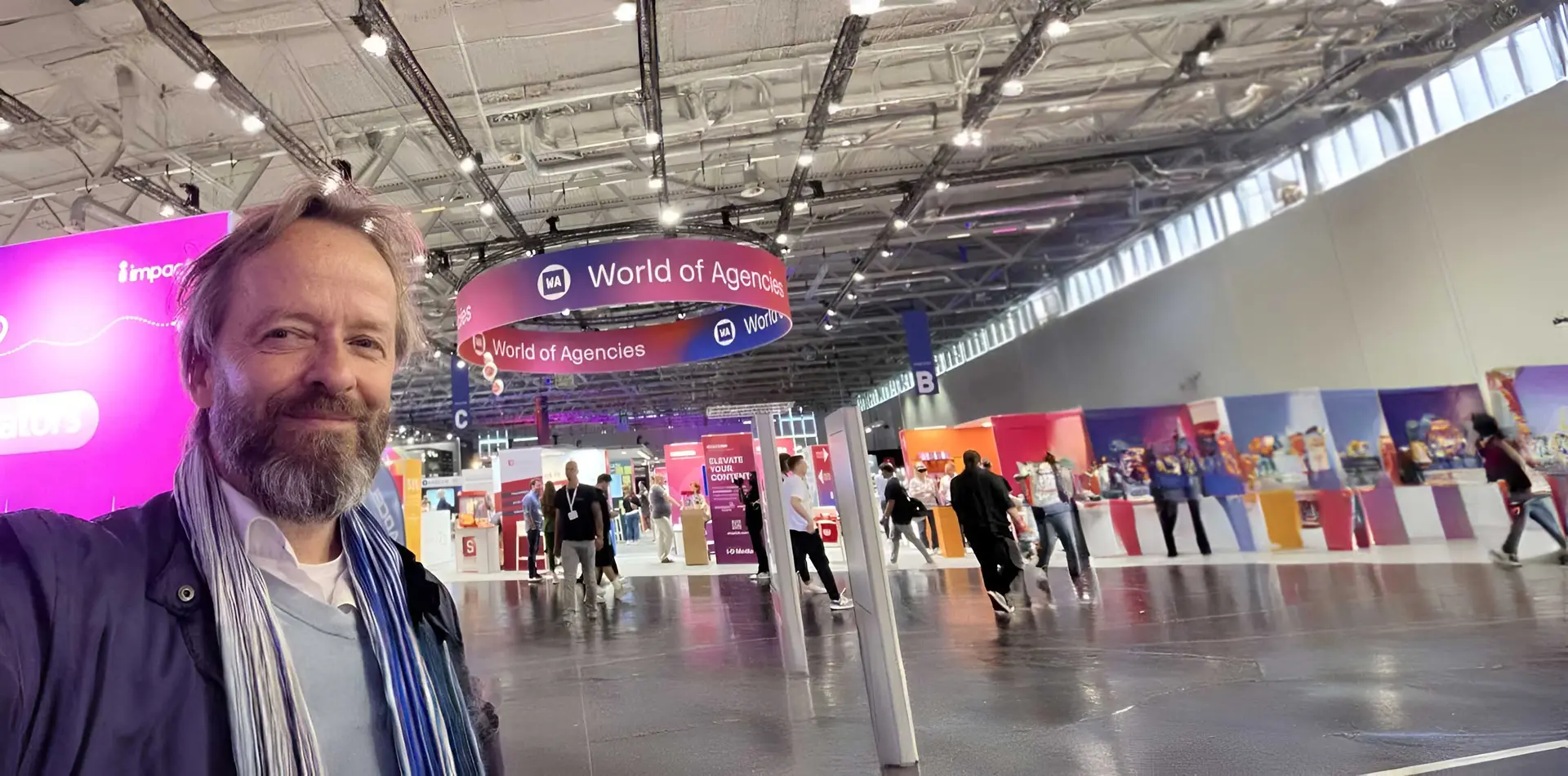
DMEXCO ´23: What will remain and what will become important?

An industry in search of itself.

First things first. When a trade fair attracts large numbers of people from far and wide, consumes vast amounts of electricity and energy, emits huge quantities of CO2 and other pollutants, uses up air, takes up space on trains, planes and motorways, causing congestion — even if this seems particularly anachronistic and completely out of step with the times in an industry that has made digital, virtual, weightless, and, above all, remote meeting its watchwords — as if all those who make the pilgrimage there and those who hold the reins in that place have completely failed to recognize the signs of the times. Nevertheless, it is an occasion to pause for a moment and ask ourselves:

"WTF - what's that supposed to mean? Does that make any sense?"

(SUPPOSEDLY) BIG ISSUES IN THIS INDUSTRY, HERE AND NOW

In the run-up to the event, the organizers called on us, whom they consider their disciples, to identify the most important topics of our time as major trends. And so we pondered and deliberated. The result was what we usually discuss here in our blog, which is quite a lot: accessibility, technological integration of PIM systems, instrumentalization of and dealing with AI, sustainability in development, cookie freedom, new opportunities for digital creativity, and much more. Or even: intercultural communication, security, overcoming barriers, helping to resolve conflicts, the big questions of our time, and other issues that we at DRIVE see as driving forces behind our work. But does our industry see it that way too? And what could we communicators achieve, both on a large and small scale, in our daily work? (You can see our list below.)

AI ALWAYS WORKS AND IS ABOVE EVERYTHING

Everyone is working on AI.

  • Pragmatic: What can I do with it, which tools should I use, for which channels, and in what way?
  • Moral: The discussion is still being conducted in this way. Even though it has long been clear that the genie is out of the bottle, the cork is gone, and the bottle is empty.
  • Technically: It is important to take advantage of the next steps in development. Some features in tools are actually AI-supported. The big AI systems are in the next stages of development. But some things are just labels, e.g., on a search feature.
  • Anxious: “Oh my God, are we all going to lose our jobs now?” No, we're not. We have time for even more great things that we can do and create now.
  • Visionary: Unfortunately, far too little, far too rare. Because there are so many great things you can do with it. Be your own director and create your dream worlds and images the way you want them. It will all be possible.
  • Legal: alongside the technical-pragmatic and creative-visionary dimensions, this is an important one. This industry could have provided important impetus at this trade fair. But it didn't, and even if it could, it probably wouldn't want to. Why?

And otherwise? Nothing much happening.

The industry does not seem to have or be aware of any other issues of particular concern. Not on the podiums, at events, conferences, on the agenda or in the calendar. The major, pressing issues that politicians and business leaders, including our clients, are grappling with, and that concern society, i.e. the people we address, are: climate change, armed conflicts, national and international trade barriers and even conflicts, political and social divisions, the resurgence of aggressive nationalism and the isolation of large groups – none of these issues are addressed here. Why is that? Denial, last year's news, escapism or simply a lack of interest?

An example: the drifting away of entire groups in society

In 2021, 23.42% of all eligible voters did not participate in the election, that's over 14 million people! By comparison, in 1972, during the Willy Brandt era, this figure was just 8.89%, and even then it was considered “a lot.” At that time, voting was considered participation in the “high mass of democracy,” a right that had to be exercised unconditionally, according to the consensus at the time. This has been lost. If you include those who vote for right-wing extremist groups, namely 7.85% for the AfD, these people make up the largest group at 31.27%. Some of them not only have values that are very far removed from those that have been considered the social norm up to now, but also their own symbols, codes, language rules, and, last but not least, consumer behavior guidelines. These are unknown to outsiders, who cannot understand or decipher them and are therefore unable to communicate with these people (see our article “How to build up a stupid community”).

So, what can communicators do to address these people? Do they even see them? Can, should, or must they try to reach a consensus with them again? At the very least, it would be worth discussing, and if not at a place like this trade fair, then where? (*All figures are from The Pioneer Business Briefing of September 19, 2023, by the way.)

This industry is too small for so many trade fairs

OMR, DMEXCO, and they are not the only ones – at some point, there will probably only be one. Exhibitors have to divide their budgets, and both are not cheap. Much of what we are seeing now looks like cost-cutting and recycling of existing material. In the process, some big ideas are likely to fall by the wayside.

Does it have to be egocentric? No.

In this respect, neither new nor slightly older agencies differ from their numerous predecessors. They all like to revolve around themselves, preferring to talk to themselves in the form of the target group they currently consider particularly important and decisive. Unfortunately, this is not a long-term strategy, but only a short-sighted one. Fortunately, there are experienced people who approach their tasks in a more systematic, comprehensive, and different way. And that's a good thing.

What remains of DMEXCO '23?

  • Good: lots of technology, system, and tool providers. Down to earth, focused on what is feasible, and making real progress. Great, keep it up and more of the same.
  • The industry: should ask itself really important questions and strive for meaningful answers. Dear friends and colleagues: let's include the world in our rather small cosmos. Let's take on tasks. Let's become important again, create value, and make “valuable” contributions in the true sense of the word, for you, your clients, the world, and all of us. In any case, that's what drives us at DRIVE.
What is really important—today, tomorrow, the day after tomorrow?

Today – time horizon: 6 months

What technological and strategic challenges and trends are currently in focus or will be in focus by the end of the year? (e.g., implementation of AI systems in the current shop system, integration of PIM systems into the marketing automation solution, etc.)

  • Yes, integration of PIM systems into marketing communication landscapes, beyond automation. Overarching theme: continuation of the digital transformation of companies and institutions. This includes complex applications and systems with customer benefits, e.g., apps for goods logistics and distribution (digital product lifecycle).
  • Digital content creation: more content, more messages, more statements
  • Cookie freedom/cookieless analysis
  • Accessibility
  • Integration of AI into development and creation processes as tools vs. individualization
  • Security: protecting data, systems, and users
  • Development of AI-supported workflows to optimize and streamline processes.
  • Sustainable brand communication. Simply painting yourself green is no longer enough, nor is buying dubious certificates. If you want to be sustainable, you should implement this in as many areas as possible and communicate it very well.
  • Social selling for B2B via LinkedIn will become an important pillar for more and more companies. It is important not to miss the boat here.

Tomorrow – 12-month time horizon

What technological and strategic challenges/trends are being considered that have concrete implementation prospects or are planned or set up as pilot projects? (e.g., metaverse sales for social selling via TikTok)

  • Sustainable UX and product design: Applying sustainability principles to the development, design, and planning of digital solutions.
  • Beyond traditional social media: Leveraging social platforms for deeper 1:1 conversations and building new systems to support that engagement.
  • Accessibility as a legal requirement, particularly in e-commerce.
  • Tighter regulations, especially around AI in text/image creation and stronger copyright protections.
  • Increased focus on cybersecurity: Alongside greater regulatory oversight on both broad and individual levels.
  • The GDPR and cookie debate continues: Many companies still rely on Google Analytics despite growing legal and ethical concerns.
  • A shift from data-driven to empathic/psychological marketing in the EU, due to legal and ethical limitations around tracking and personalization.
  • Demographic change. How will companies compensate for the loss of employees? And what measures will ensure that their own employees stay with the company in the long term? Exciting challenges for corporate communications and employee marketing.

The day after tomorrow – time horizon 36 months

Which technologies/digital developments are important for the market in the medium to long term? (e.g. Fediversum, AI-based agency)

  • Integration of the entire digital user journey across all tools and touchpoints, with a further increase in the quantity and quality of digital touchpoints, even more tools, apps, services, offers, and more links between them; this will result in higher demands on control, handling, creation, design, and production.
  • Greater integration of users in the dialogue process and, through this, in the company, while improving analysis options, providing more insights, and enabling more dynamic exchange.
  • Simplify navigation and interactions between end devices, going beyond the individual device. All end devices become one large system, connecting and linking applications and devices.
  • How will augmented reality change the way we work and use media in the long term? After hearing little about Microsoft's HoloLens, Apple's vision suggests that this topic should be explored further in the future and may become bigger than many thought.
  • Virtual influencers. These are still relatively easy to see through, but with the advancement of AI, they will also get better and better. An exciting opportunity for companies. But also a challenge for society. Will AI soon be telling us what to buy?

We see, listen, perceive, develop, and think. We analyze and have a great deal of practical experience. And from this, we then work with you to shape the next steps. It's also just a lot of fun. And if we happen to be wrong, which is very, very rare and only a remote possibility :), or if the world turns out to be a little different after all, we will adapt immediately and change course, as one should.

More blog posts

You've won the European Heritage Seal! What a wonderful honor!

COMIC artists sharpen perspectives, seek new paths, and open up worlds. We are preparing a utopian-dystopian exhibition of visionary comic worlds at…

Digital battles are raging, including for children's minds. Social media companies have stepped up their game – but are children even prepared and…

Stephan Probst had the honor and opportunity to draw with the great comic artist Xu Jingru from Shenzhen at the International Comics Seminar.