What is A.I. doing with text and strategy?

The excitement surrounding A.I. shows no signs of abating. Are copywriters and strategists now all redundant? It could hardly be more catastrophic.

Here is an overview of all the changes to the text, strategy, and concept, with suggestions for classification and evaluation. Enjoy reading, and please feel free to share your thoughts and feedback.


Who still needs text written by humans?

Artificial intelligence (AI) can do everything, and much better! The miracle tool here is Open ChatGPT, short for “Generative Pretrained Transformer,” a tool that supposedly writes complete texts independently from simple work requests, known as “prompts,” based on rules and prior knowledge. The way it works is similar to the generation of images by AI, as shown here: https://www.drive.eu/en/drive-blog-en/blog-detail/does-ai-kill-creationThe texts created by the software are based on statistical probabilities of certain words following others, i.e., not on the verification of facts or the evaluation of perceptions, but on what has already been written elsewhere. The more of these, the more reliable the text is supposed to be; the fewer, the less reliable.

The hype and fanfare surrounding it are huge: Will all, or at least many, copywriters now become unemployed because machines are taking over their work, namely writing reasonably intelligent, readable texts? That, at least, is the great fear that is circulating. But can AI really do as much as promised and feared? Here is a brief overview of some examples and experiences.


Create SEO texts

This work is simple: stupid texts are cobbled together from building blocks and synonyms according to Google rules for search engines. The main thing is that every possible keyword that anyone might search for is included: the “main word,” synonyms in all possible dialects and relevant foreign languages, as many applications as possible, a little bit of everything, not too much and not too little. It sounds pretty simple, and it is. A.I. is good at this, and human creativity and lifetime seem to be truly wasted here, because no one reads this stuff anyway except the stupid Google A.I. Search engine copywriters whose job this would be should start looking for warmer clothes in the future. (Google is, of course, trying to combat this and use even more sophisticated rules to determine whether a text is man-made or machine-made. Honestly, they only have themselves to blame.)

Writing lexical knowledge texts – “homework help”

Extracting something extra from what already exists and generating something new from it is something AI does well. It takes existing information and texts, establishes relationships between words, derives rules that it thinks it recognizes, and creates its own material. Wikipedia is an important source.

This can be perfectly adequate for simple homework help, e.g., when only facts are being asked. But if the teachers asking the questions were to ask more complex questions, e.g., expecting classifications and evaluations, AI would quickly reach its limits. This is because it can only refer to what already exists.

Filling out forms – a good improvement

Hurray, a useful application! This can really save people a lot of tedious work and valuable time. Prerequisite: People must be well organized and have everything sorted out in advance, e.g., personal data must be stored digitally in an orderly manner. Grandpa's box of old receipts is no longer sufficient for tax returns or other forms.

Writing applications

For some people, writing applications is so tedious that they would probably prefer to have them generated by AI (and some applications actually read as if this were the case). The trade journal t3n decided to try it out for itself. Depending on the prompt, the results were at least formally correct cover letters and self-descriptions, some of which were created based on questions from the AI. However, the more demanding the job advertised, the less adequate the AI's results were. This means that if you want to apply for good jobs, you should develop and present a few thoughts of your own. Intelligent readers will recognize this.

“AI-generated campaigns” – do they exist?

No. Although this is claimed, for example on OMR (German-language link): Germany's first AI-based campaign. But what is happening there is that only images generated by AI are being used. And since this is explicitly stated, they are simply riding the wave. So here, too, there is a human mind behind it, not an artificial one, who came up with the idea, regardless of whether you think it's good or not.

Find out the latest news and facts for yourself

This is something that AI can quickly fail at.

  • Breaking news – it can't do that at all. Because it can only understand something if it has already been written down. But is that really true? It's best not to ask AI that question, because how would it know?
  • Fact checking – it can't do that either. Of course, it's even more likely to repeat false information, because AI simply accepts something as true if it has been written down often enough. (Ancient historians face a similar problem – there are few counterarguments to the writings of the victorious side. We would be just as unenlightened today, see social media echo chambers, lateral thinking forums, and much more.)


An initial assessment – Be creative and stay creative!

What we learn from these examples.

  1. When researching facts, performing standard tasks such as filling out forms, and anything else that requires simple reproduction, AI is good. It can make life easier for creative professionals in terms of text and strategy in some areas. This is exactly what we need to make our work easier: more free time as a resource for creative work.
  2. Clerical work and administration, everything it assists us with – AI is good at that too.
  3. Lists and results: weather reports, sports results, etc.
  4. New, current events remain foreign to AI for the time being; someone else has to be the first to break new ground. It is not capable of taking big steps for humanity on its own, even if it may already be one itself.
  5. Classification and evaluation, which are usually the final steps of a proper analysis, are beyond its capabilities.
  6. Trulyindividualcreation: AI cannot achieve this on its own either, which is what a free mind should be there for (even if repetition and collage are creative principles, with nods to hip hop, Dada, Picasso, and many others).

The “Jarvis” concept = mastermind of the “vision” (those in the know will understand), namely a machine mind capable of free reflection and proactivity, is certainly the goal, but it has not yet been achieved, so there is plenty of time to adjust to it and learn it ourselves.

Where are the dangers lurking?

  • Yes, anyone who has zero interest in creativity is initially at risk from AI. And there are certainly quite a few people like that, which is why this opinion may seem somewhat elitist at first glance. But please also see it as a call for individual liberation (though not very popular nowadays, it may seem).
  • Because: A.I. creates boredom effortlessly. It produces the same thing over and over again, the same motif in countless variations, but without any development, and that quickly becomes tiresome. In our article https://www.drive.eu/en/drive-blog-en/blog-detail/does-ai-kill-creation, you can see this clearly in the examples.
  • “Truth” – what is that? AI doesn't care about that at first. And that's why you shouldn't trust it. Not with important information and facts, such as breaking news, insurance data, and anything else that is actually important and of high significance, especially when important decisions have to be made based on it.
  • Legal restrictions: AI can't make it that easy for itself, as it violates every copyright imaginable when collecting, browsing, and processing data. In the case of images, Getty Images is suing Stable Fusion's image AI for leaving the image agency's watermark in the images – it couldn't be more stupid. The ruling will set a precedent.
  • Prejudice, lies, and deceit – AI is good at that too. Let's not kid ourselves – it won't make the world any easier, because AI only repeats what it has been fed, which in case of doubt is nonsense.

The bottom line: Without good copywriters and strategists, the world won't be able to survive for the time being.

Outlook – where are we headed? How can I avoid fake news, mistakes, and “lazy content”?

  • Even more formatting, standardization, and simplification to produce content have always been the desire and goal in media content production. If costs are to be reduced, recipes that are easy to produce must be found. Not much else is happening here for the umpteenth time. We have to assume that many content producers will initially see this as a supposed “opportunity” and want to produce content accordingly. In any case, this will include SEO texts, but also a lot of basic content, clickbait content, supposed knowledge texts, and much more—the many apparent dead formats from the afternoon TV programs of the 1990s send their regards.
  • The problem with this is that if you want to minimize risk, you end up “in the middle,” i.e., finding and creating content with the highest “accuracy” for as many people and ‘tastes’ as possible, which then forms the “mass taste,” the “mainstream.” And the more providers do this at the same time, the less distinguishable they are from each other, the more interchangeable they become. The fate of format radio, its creeping demise, should be warning enough. But this is how many classic marketers proceed when they formulate content profiles on the drawing board.
  • Discerning users demand more: they want better content, more than just repetition, but also reflection, differentiation, distinctiveness, and in some cases variation and further development, if not outright surprise instead of constant repetition. But we know from media research that repeating the same content patterns also has a confirming and thus stabilizing function for users. It conveys security and consistency. And let's not kid ourselves: it's not always geniuses sitting in front of the screen, on either side. Sometimes both sides just want to make things a little easier for themselves.
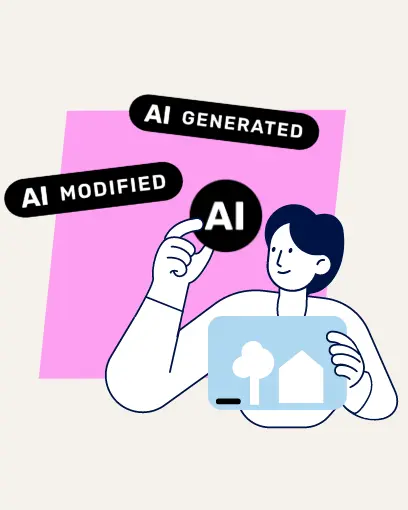
  • The authenticity problem: AI can produce fakes, errors, and “lazy content.” Content that appears to be correct but is actually false, flawed, and in no way “real.” Users cannot (yet) distinguish between the two. It is up to content producers to prove this.

So what does a good strategy for text and content look like? How can I avoid the “stuck-in-the-middle” problem?

  • Exploit potential: SEO text is just ‘material’; “outsource” this and other basic content.
  • Be really good at what you do: develop your own profile and produce excellent, unique content.
  • Be authentic: prove that your content is genuine and unique.

More blog posts

You've won the European Heritage Seal! What a wonderful honor!

COMIC artists sharpen perspectives, seek new paths, and open up worlds. We are preparing a utopian-dystopian exhibition of visionary comic worlds at…

Digital battles are raging, including for children's minds. Social media companies have stepped up their game – but are children even prepared and…

Stephan Probst had the honor and opportunity to draw with the great comic artist Xu Jingru from Shenzhen at the International Comics Seminar.