Artificial Intelligence, kurz A.I., kann alles, das am besten und am laufenden Band produzieren: super schick, vielfältig, voller Details und mit unbegrenzten Möglichkeiten. Ein paar Ansagen, ein, zwei, drei Mausklicks und schon sei die neue Bilder-, Text- oder Irgendwas-Welt fertig? Und dafür geht eine große Angst unter Kreativen um: Wird uns diese neue, wundersame Technologie ganz oder mindestens teilweise ersetzen? Wo bleiben die Künstler, Handwerker, Kreativen als Schöpfer und Gestalter, wenn die Maschine alles kann und möglich macht? Und was macht das mit der Kommunikationsbranche insgesamt? Was bedeutet dies für Kommunikation als Profession, als Aufgabe und Funktion, wenn ein Programm im Prinzip alles selbst erstellen kann?

Does AI kill illustration and graphic design?
What AI can do in illustration: A lot!
This is currently being discussed particularly intensively in one area: illustrators and draftsmen. For many of them, the situation is as follows: AI can do everything that many of them offer, namely designing images with fantastic motifs of all kinds and ideas, in any style, with figures, situations, objects, everything their clients could possibly want. Only it does it faster, much more, and above all, cheaper. This causes fear of losing jobs, interest, work, and income—AI seems to threaten the very existence of illustrators, at least for many of them. So the situation is very serious for now.
A.I. builds the image world just the way you like it
How it works: Images are generated from text inputs based on existing data and a flood of crawled images. Enter terms into an AI generator and the system generates images from them. Here is a well-explained summary by illustrator Sandra Süß on how such image AI works (German-language link): https://sandra-suesser.de/ki-kunst-probleme
- The AI collects data and images. It crawls the internet, searching for and collecting all images and the associated tags and meta information.
- The AI sorts and learns. Up to this point, images were just pixels. Now, based on the information, it establishes relationships to distinguish and organize the motifs, more and more, again and again.
- The AI creates multidimensional spaces from terms, texts, and images. Here, all terms, objects, and images can be positioned and classified as parts, as concepts in space. This creates a basis for generating new concepts and thus images from terms.
- The AI generates the images based on entered terms and specific images, known as “prompts.” You enter your terms in combinations and the AI creates images based on its previously created basis.
- The AI learns from you. And in the process, it becomes more and more accurate and better.
That sounds pretty simple. Want to redesign the image of a room, the scene, the location with objects? No problem. Want your characters to look like famous role models? Just a moment, please. Thanks to the integration of random factors, the images are never exactly the same. Instead, they always contain a new and surprising element, which makes them particularly fascinating right now, in the early stages of this technology: with lots of details, in all kinds of styles, from hyperrealistic, which would take some illustrators hours or days to create, to images in the style of famous role models.

AI in all media and creative fields
AI works in a similar way in other areas of the creative industry, where it has been used for a long time. Here are a few examples.
- Search engine optimization: This requires large amounts of text to ensure that a website can be found easily. The text doesn't have to be beautiful or even easy to read. The main thing is that it contains the right keywords, i.e., terms that will satisfy the search engine. This means that millions of search engine copywriters are becoming redundant, because AI can do what they do, and just as well.
- Logo creation and design: for some time now, a website has been offering logo design at low prices well below the usual rates. No long briefings or explanations: "Who am I and what do I actually want here" as a company, but rather a quick and clean, supposedly cool text-image thing that can serve as a logo for at least some time. It was enough for many clients, and it took a while before the supposed deception was discovered.
The possibilities for using AI to create communication content are not even close to being fully described. (>>> Wait for more)
- Social media feeds: The generation of home pages with content is nothing more than AI that offers content based on what it calculates to be your interest profiles. With every click, every like, every comment, you make the AI more accurate and smarter, and it can supposedly offer you better posts.
- Formatted radio and other entertainment: Radio is a machine. This began in the 90s with the categorization of music by categories and keywords, the creation of profiles based on time of day and user groups, and ultimately led to the medium becoming boring. Spotify is just the next logical step on this path. The same applies to TV, movies, social content, and virtually everything that is produced purely on the basis of data and analysis. Who needs creative minds when machines can do it much more accurately?
- Comics and books: Enter your terms in the right order and AI will build you not just individual images, but entire books, with or without pictures. It sounds so simple.

- “Art”, recent example: A user had an AI crawl through images of the recently deceased artist Kim Jung Gi. He claimed that this would enable him to create new images “in the style” of the artist and that he would thus preserve his legacy for posterity. At this point, at the latest, many users began to feel cynical. Or ridiculous, depending on their position.

Problems, fears, and concerns surrounding AI.
This raises many problems and discussions. In theory, AI allows anyone and everyone to create images, design, and work as an illustrator or designer. For many, this creates a fear of being replaceable. After all, why employ designers when AI can do everything much faster, cheaper, and more accurately? Sandra Süß summarizes the criticisms of the technology well in the article mentioned above.
- Data misuse: Practically everything that is published anywhere by anyone at any time is used and exploited by AI crawlers. This is no different for image engines than it is for other search engines.
- Artists and their works, images, are used without permission as sources and are greatly harmed in the process.
There is not much to counter either argument; it is simply a fact. Anyone who publishes something on the internet must always be aware that someone else can do whatever they want with it. In Europe, we try to counter this with legal means such as copyright law and data protection. But this is a long and arduous path.
- Much of the work previously done by artists, creatives, craftspeople, and other designers can be replaced by AI results. This could lead to the loss of many jobs and work opportunities in an already highly competitive market with often very low pay.
- Fake images, fake news, fake facts using AI: This is not a new accusation against image creators and the media. They are accused of misrepresenting contexts with images and ultimately lying. With AI, this would be even easier and would actually affect everyone: Anyone's image can be stolen, altered, and used in all kinds of scenarios, both possible and impossible. It is becoming increasingly difficult to distinguish between truth and falsehood; this is something that has to be learned, and it is not easy.
- Devaluation of “art,” because “in the style of ...” is not the same as the original work by the person. But what is “art”? Is it tied to a specific material, a work material, or a process?

AI as a tool – how artist Steff Murschetz uses it
And this is precisely where others take a different approach, namely a positive and proactive one. One example that definitely deserves mention is the artist and colleague Steff Murschetz, currently the innovator, trailblazer, and pioneer in the field of AI in the German-speaking world in 2023. He advocates an open and free approach to AI: "... Is the advice to stay away from AI really so good for illustrators? Isn't there an advantage to mastering and being able to use the new technology? Aren't we missing out on the opportunity to shape this art form and set ourselves apart from the masses of images generated by amateurs by bringing our drawing and storytelling talents and experience in image editing to bear? ..."
On his Facebook profile, Steff clearly shows how he uses AI as a tool in the creative process to tell and develop situations and stories in his own personal style. It's important to note that he is himself an outstanding and distinguished artist with great technical skill and stylistic range. He “feeds” the AI with his own work in order to create something new in his own style. In this way, he continues to improve his work process with this new tool and ultimately master it as far as possible.
https://www.facebook.com/steff.murschetz

The interim result: Good creation makes a difference
This new form of AI technology is still in its infancy. It is the subject of heated and controversial debate. This is hardly surprising, given that there is so much at stake, often including the fear of losing one's livelihood. But: ...
- AI can produce a lot, including a lot of junk. You can see it in the mostly endless sequences of images in great variety: they quickly become boring, repetitive, flat, and their fascination soon wears off in the long sequences. Nothing new comes along, it's always the same thing, just a little bit different.
- Average is often enough—this is no different with AI than in real life, and the stories of many other media and formats show this. Take radio formats, for example: Of course they're boring, just like afternoon TV programs and many other entertainment formats. But in many cases, that's enough. And at some point, they've had their day. Unfortunately, their audience is often not very discerning, so everyone gets what they deserve.
- Sometimes clients just want “average” from designers? Probably no one would admit that. But by the time a design has gone through countless decision-making processes from the initial idea to final approval, the rough edges and unique features have often been smoothed away (of course, that's never the case with us). Compromises often make results appear more compatible. The good news is that such work also disappears quickly and is not easily remembered. Good creation makes a difference.
- AI cannot always do everything yet, e.g., count or depict fingers on hands correctly. There are funny examples of this—a teething problem.
- The demands on designers are increasing enormously: Is what I produce really good enough? What makes my work unique, original, different, and hopefully better? Or do we often fail to produce the great, outstanding work we once dreamed of?
Would you like to see more examples? Go to Midjourney Official Group on Facebook

The way to move it
The approach taken by Steff Murschetz and many other international artists is completely different.
- A.I. can be a tool in its own right. It is still in its infancy and needs to be tested and developed further. But when used correctly, it can offer a wide range of possibilities.
- For example, AI can be used to quickly and easily test approaches in creative discovery and design phases. This can save time and effort and also lead to new solutions.
- AI can make productions more cost-effective, for example by combining and animating longer sequences, creating details and backgrounds, and much more.
- The legal issues surrounding copyright protection and image rights must be addressed and resolved. Are the existing means of protection sufficient to prevent “in the style of” creations or images with my image or an image similar to mine, or to only allow them if I have given my consent? This is an urgent issue.
- Individual handling of one's own images must be improved and learned. How can I protect myself from unhindered crawling of my content? Do I have to post everything about myself freely and without restriction online and present all images and information to AI?
- How can I improve as an artist and designer? Become more original, more individual, more surprising? How can I convince my clients and my audience of myself and my work? How can I prevent my work from becoming interchangeable? Can AI help me with this, or what is stopping me? Steff Murschetz shows us how.
In any case, and here I agree with Steff Murschetz: Demonizing new technologies and focusing solely on the negative aspects has never helped. AI must be analyzed, learned, and mastered; it must be used skillfully. Rules must be defined for how it can be used and how theft and misuse can be prevented. Opportunities for learning already exist. We have to get started and approach AI as an opportunity.

Good design
Quality in design, competence, and skill are evident in the special details, not in hyperrealism or simply stringing together the same things over and over again. It is not the quantity of details that is important, but rather choosing exactly the right ones. Less is usually more. Knowing what to leave out is a skill that must be learned.
Help to defend yourself
With the “Have I Been Trained” platform, you can check whether your own image material has ended up in the Laion-5B database, which is used to train Stable Diffusion's AI, for example.
https://haveibeentrained.com/
Links
- AI in graphic design: https://www.drive.eu/en/drive-blog-en/blog-detail/where-ai-can-help-us-generative-design-in-design
- AI in text and content: https://www.drive.eu/en/drive-blog-en/blog-detail/what-is-ai-doing-with-text-and-strategy
- AI in development: https://www.drive.eu/en/drive-blog-en/blog-detail/ai-in-development
- AI in illustration and image design: https://www.drive.eu/en/drive-blog-en/blog-detail/does-ai-kill-creation
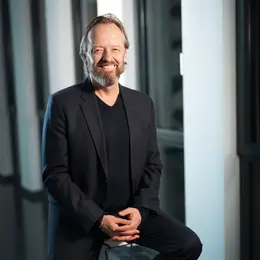
Stephan Probst
More blog posts
Spotting Deepfakes: The European Commission Launches New AI Labels
Artificial intelligence is transforming how we create content. But how can customers tell if an image, text, or video is authentic? The European…
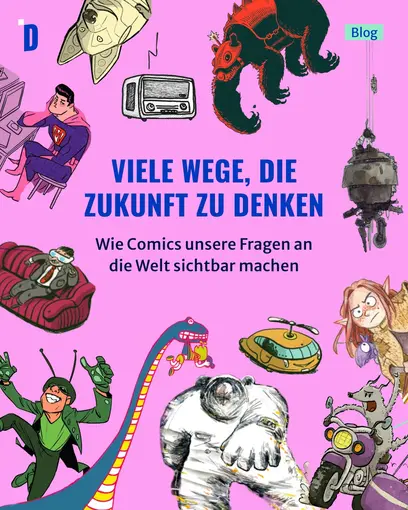
Many Ways of Imagining the Future – How Comics Make Our Questions About the World Visible
Comics tell stories in a unique way. They can make complex themes visible, reach different audiences, and open up new perspectives on our present and…
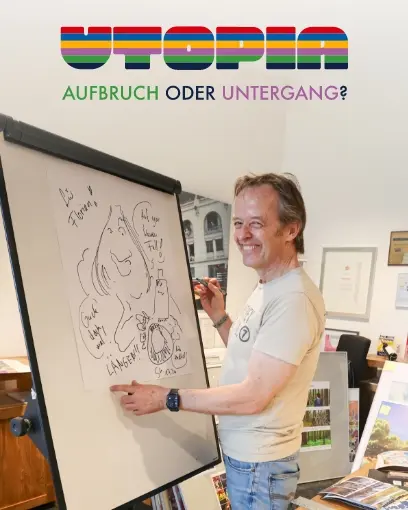
UTOPIA in the Press and on Social Media
The exhibition “UTOPIA – Breakthrough or Collapse?” has been described in local reports and announcements as an absolute stroke of luck and well worth…
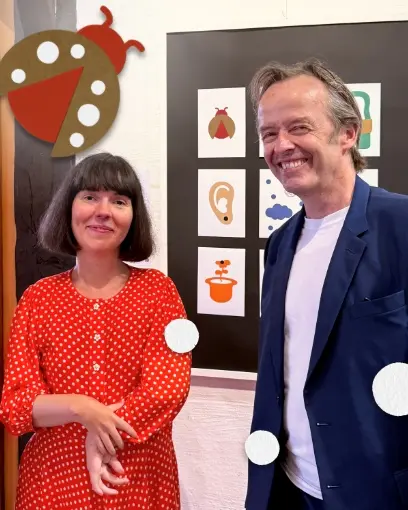
Points That Connect Worlds: My Conversation with Hatiye Garip About Accessible Art at the UTOPIA Opening
Conversation with Hatiye Garip at UTOPIA: About her tactile artwork “Finding the Dots”, accessible art, inclusion and participation.