The melodious music draws you in from the next room. Passing through a black thread curtain – like entering another world – you suddenly find yourself surrounded by projections that radiate onto the walls and floor of the large room and are refracted in the mirrored columns. Animations combining excerpts from centuries-old paintings, 3D computer animations, and geometric abstractions of buildings from a bygone era have a mesmerizing effect. It feels as if you are inside a larger-than-life kaleidoscope.
WHAT WE CAN LEARN FROM DA VINCI

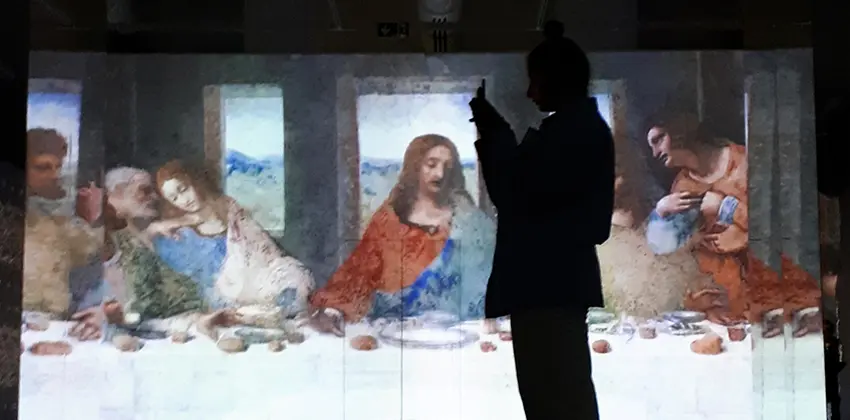
DRIVE went on an excursion to the State Museum in Hanover, where we visited the multimedia exhibition “Leonardo's World.” From the very first moment, we were immersed in the mind of the genius and visionary Leonardo da Vinci, and the boundaries between work and reality became blurred. Realized with the help of film, sound, and projection, the room installation is an impressive example of modern storytelling. The contextualization at the beginning of the exhibition was achieved in an almost playful manner. During a video presentation, we learned about da Vinci's life, encountered the artist and inventor as a realistic hologram, and gained an impression of his most famous paintings.
The impressions fascinated and inspired us greatly. We are now left with the question: What can we learn from da Vinci? What inspiration and motivation can we draw from his way of thinking?
Myth and polymath
Leonardo da Vinci is a myth – a universal genius who combined art and nature and was far ahead of his time with his creative ideas.
The outstanding inventions and works of art of Leonardo, who was born in the Tuscan village of Vinci in 1452, still inspire us today – half a millennium after his death. He left behind countless sketches, drafts, and studies. He designed a wide variety of flying objects, planned an underground sewer system to improve hygiene in Milan, which was plagued by the plague, and created the precursors of modern inventions with his designs for catapults and fortifications. Many of his most famous paintings were the product of his genius, including the “Mona Lisa,” the “Madonna of the Rocks,” and “The Last Supper.”

Da Vinci may well have been the greatest visionary of the Italian Renaissance. Powerful, influential rulers sought his advice and his art. But he was not driven by fame and fortune in his work, but rather by an insatiable curiosity and perfectionism. As a result, he embarked on countless projects in a wide variety of fields during his lifetime, without ever completing many of them.
How can a single person study human anatomy, be an enthusiastic scientist, sketch functional machines, and revolutionize Renaissance art at the same time?
If you want to grow, you need role models to strive for. So what lessons can we learn from the life of Leonardo da Vinci?

Learn like da Vinci
Intuitive and unrestrained
Leonardo da Vinci was a master of free thinking. Today, we would probably call him a “think outside the box” person. He saw connections that had previously gone unnoticed and opened up new areas of knowledge by linking different subject areas. He broke out of old patterns, rethought art, and thus worked in the spirit of the Renaissance—unbound by the social norms of the Middle Ages.
He shows us that we need to think across departments and not insist on one skill. Phrases like “we've always done it this way” slow down processes and need to be banned from everyday work. Nothing is impossible!
Instead, we need to trust our imagination, find enthusiasm for the unusual, and not be afraid of failure.
Da Vinci was known for recording his thoughts wherever he was and always carried a notebook with him on all his travels. He left behind several thousand pages on which he recorded his studies.
We must follow the artist's example and view the world with an open, analytical eye and broaden our interests. This will give rise to new impulses and combinations and thus unknown possibilities.
Lifelong learning is necessary to continuously develop ourselves and our skills and to stay up to date. We must therefore make use of the pools of information that are so easily accessible today. These are the advantages we have over da Vinci and which everyone in today's digital world can benefit from.

Curiosity and perfection as driving forces
Leonardo was probably a perfectionist. It stands to reason. Why else would the Mona Lisa have been painted with such meticulousness and attention to detail? Why are there countless unfinished works? His drive for perfection was what drove him. Coupled with a curiosity to understand the world and question the status quo, he was able to revolutionize art and create innovations that the world had never thought possible before. From our childlike curiosity, which may seem to be buried deeper in some of us than others, we can draw energy and enthusiasm to break new ground and think in new ways.
Problem solvers – inventions for people
Many of humanity's developments were the product of an acute problem. This was also true of da Vinci. He drew his innovative strength from the search for solutions.
So how can we set in motion and accelerate processes that help people? We must respond to the needs of the times. We must observe, understand, and work in a human-centered way.

Stand out from the crowd
Create connections where none existed before. Take unconventional paths. Consider the extraordinary. Surround yourself with people who inspire you. Break habits to leave your comfort zone.
Leonardo da Vinci's creativity stemmed from a childlike enthusiasm for the unknown. As a creative person, you can draw inspiration from everything. But only if you continue to learn throughout your life will you develop and be able to see previously unknown connections and stand out from the crowd.

Stephan Probst
More blog posts

Advertising that thinks ahead? How ChatGPT Ads are changing online marketing
We know advertising on Google. Advertising on Instagram, too. But advertising right in the middle of a conversation with an AI? That is now a reality.

Visual Knowledge: Image and Video as a New Language for SEO and GEO
Companies have far more knowledge than what is visible on their websites or in traditional marketing materials. Products, applications, expert…

SEO and GEO: one shared philosophy for greater visibility
Creating content for a website today means more than simply publishing information and waiting for someone to find it. Search engines and new AI tools…

Poetry Meets Performance: Why the Future of Content is a "Sandwich"
Brands today face a seemingly impossible task: they must touch the human soul while being perfectly understood by artificial intelligence (GEO) and…