Use of fonts in web projects

How we deal with the Google Fonts issue at DRIVE

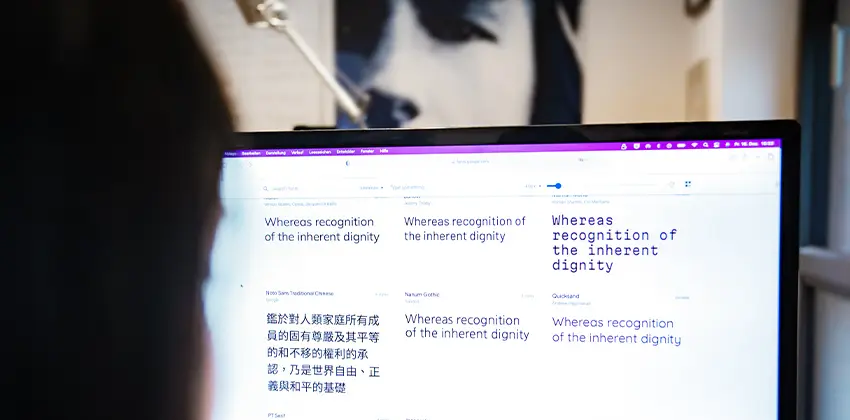
Fonts are an important visual component in the design of any communication tool. However, for many designers, they are currently more of a burden and a source of frustration than a source of design inspiration, especially in web projects. This is because, due to data protection regulations, Google fonts can no longer be used in the same way as in the past. And “greedy, busy warning lawyers” have discovered a lucrative activity for themselves: they send warnings to website operators who have not integrated Google Fonts in compliance with data protection laws (we award points for long technical terms) – this is easy pickings for them.

So what can be done? How can websites still be designed with good typography? Read on to find out how we at DRIVE are solving this problem.

What sources are available for fonts in web projects?

We can use the following sources for fonts:

  • Adobe Fonts: Adobe offers its own font packages for designers in its programs. This seems good because they are easy and quick to use in the design process. They also offer a wide variety of well-designed fonts. The major drawback is that anyone who wants to work with a project designed in this way, now or in the future, will need their own Adobe license! This means not only the designers, but also the respective clients, all programmers, and many more. Purchasing these necessary licenses means additional costs for the project.
  • Google Fonts: The wave of warnings due to violations of data protection regulations is causing great lament among designers. The large selection of fonts at Google was so easy to use and so diverse! And now it's all supposed to be over? NO! Because Google fonts can be used in compliance with data protection regulations! You just have to know how (and we'll explain that below!).
  • Purchased fonts: These are classic fonts purchased with licenses for specific purposes. They are always easy to use, provided that the license covers the respective purpose, period, location, and medium. However, additional costs may arise in the run-up to a project, which are difficult to calculate if you have not already decided on a font in advance! This is because the font cannot usually be tried out in advance in the layout and tested in all possible scenarios. This means that only if a CD decision has already been made in advance and a font has been specified can this solution be used and calculated reliably. Of course, this is usually a good solution from a design perspective.

Which fonts and their sources are problematic, and which are not?

Google Fonts are okay!

IMPORTANT For the reasons stated above, these font files must NOT be embedded in the programming via a link. If they are, they will be accessed by servers abroad, which violates data protection laws.

The solution is as follows: The fonts must be downloaded and stored on our web servers or those of the client. This means that, from a designer's point of view, Google Fonts can be used! This is a perfectly viable option and the variety of fonts available remains unchanged (until further notice). Designers can rejoice (also until further notice).

Adobe Fonts are not okay!

This is because they are severely limited in many ways:

  • Fonts cannot be downloaded for web implementation. They can only be accessed via a link.
  • In InDesign: Fonts cannot be packaged and may not be passed on. Each user requires a license and must activate it themselves. This results in the high costs described above.
  • Clients are not allowed to simply adapt files themselves later on due to license restrictions. And we are not allowed to pass on the fonts. In practice, this is often unworkable and conflicts with many client requirements.
  • Individual licenses can be purchased from other providers. However, their specific license terms must be carefully reviewed!

Purchased fonts may be okay. But they don't have to be.

The procedure for purchased fonts must be as follows: Before using a font, i.e. before it is suggested to you as a client, the license of the respective manufacturer or provider must be checked. Does it also apply to the intended purpose? Everyone must protect themselves here: the client as the future user of the font and us as the designer. Important factors include the intended use, medium, time, location or area, and other details. This should be clearly documented in writing for all parties. If everything is in order, i.e., all necessary licenses have been obtained, then purchased fonts are acceptable. If not, obtain the licenses as soon as possible. Otherwise, do not use the font.

The logical consequences at DRIVE

For us, the logical consequences are as follows:

  1. We only use Google Fonts and ensure that they are integrated into the development in accordance with data protection regulations. Or: ...
  2. We use fonts provided by clients, i.e. purchased fonts, provided they have a valid license. We check this together in advance.

Additional links

You can find more information here.

More blog posts

You've won the European Heritage Seal! What a wonderful honor!

COMIC artists sharpen perspectives, seek new paths, and open up worlds. We are preparing a utopian-dystopian exhibition of visionary comic worlds at…

Digital battles are raging, including for children's minds. Social media companies have stepped up their game – but are children even prepared and…

Stephan Probst had the honor and opportunity to draw with the great comic artist Xu Jingru from Shenzhen at the International Comics Seminar.