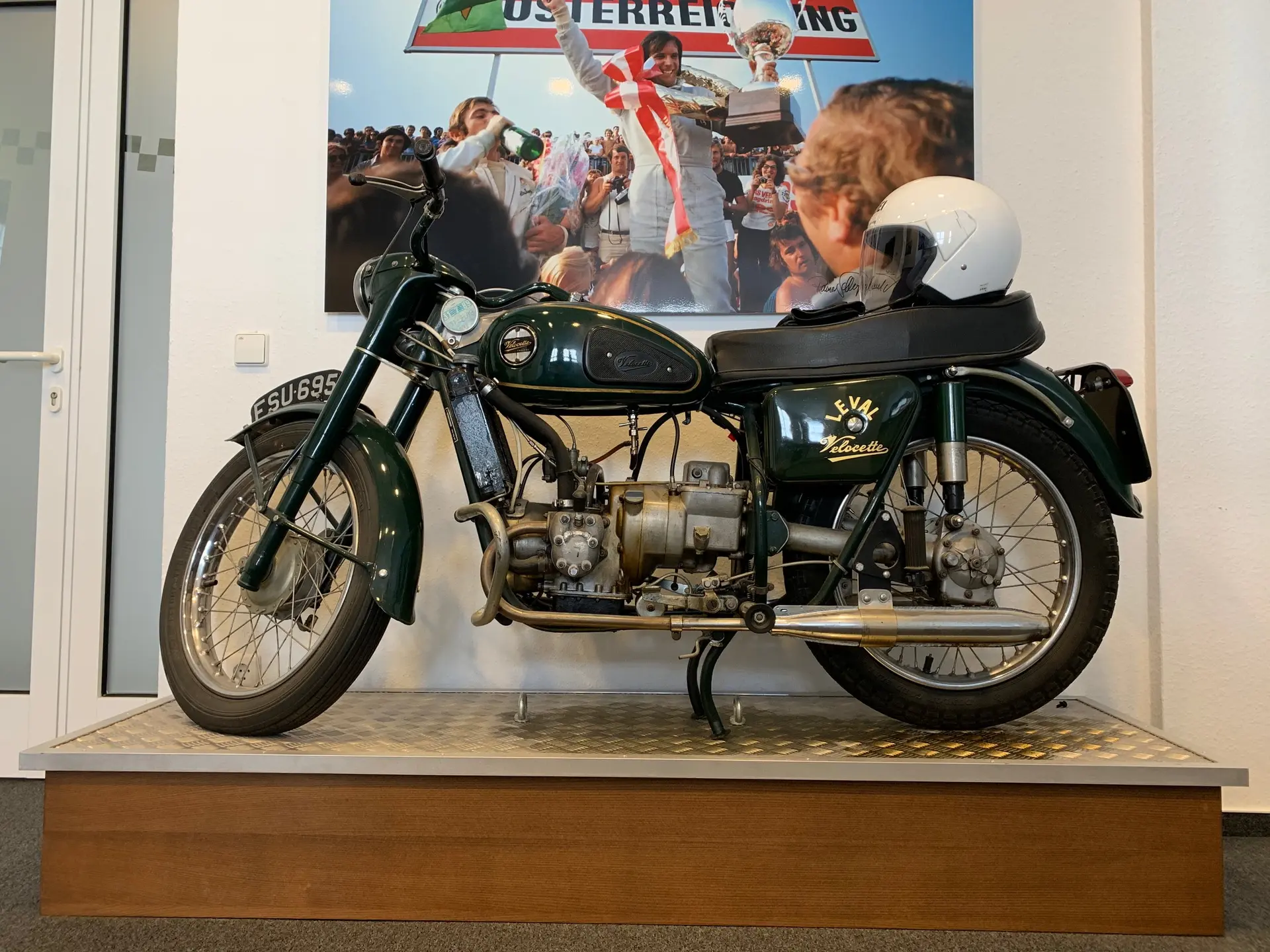
The British police's “Noddy Bike”
Here, Walter Probst has compiled the history of this very exciting motorcycle, with excerpts from “Motorcycles – Famous Brands from AJS to Zündapp” by Dr. Helmut Krackowizer, 1989, page 270 ff.
Here, Walter Probst has compiled the history of this very exciting motorcycle, with excerpts from “Motorcycles – Famous Brands from AJS to Zündapp” by Dr. Helmut Krackowizer, 1989, page 270 ff.

Hardly any other motorcycle company's fate is as typical of the rise and fall of the motorcycle industry in England as that of Velocette. Its sporting history boasts unique highlights and successes from 1921 to 1961. The company's contribution to motorcycle technology is also much greater than one might think. Not only did it invent the internal caliper brake and the foot-operated gear shift, which always returns to neutral (positive stop) and is now standard, but Velocette also designed the rear suspension with swing arm and spring struts, which is now common on motorcycles. Velocette's famous KTT king shaft engine is the epitome of the English single-cylinder high-performance engine developed down to the last detail, whose design was ultimately adopted by the well-known Norton company.
This is because the company's founder, John Goodman, was originally called Johannes Gütgemann and came from Germany. At the age of nineteen, he moved to England in 1876, got married there, and started producing bicycles with a Mr. Barrett in Birmingham at the Taylor Gue. Ltd. company.

And Velocette achieved respectable results right from the start, finishing in 3rd, 5th and 7th place. In the meantime, John Goodman's sons Percy and Eugene had joined the company's management and in 1924 decided to develop a powerful four-stroke model, which was tested in the TT a year later before going into production.

These figures demonstrate the significance and superiority of these racing models, which were developed step by step to perfection. Between 1926 and 1939, Velocette worked its way up from being an almost unknown brand to one of the most respected companies in motorcycle racing and technology, even though it was a dwarf by today's standards.
In 1939, production was just over 100 machines per week.
The management of the family business realized that the future of two-wheelers lay in a different direction.

This vehicle was used to equip the English police on a large scale, so that by the mid-1960s, almost the entire LE production was delivered to the police.

Despite the sales success of the LE, Velocette, like almost all other English motorcycle manufacturers, eventually ran into financial difficulties, and the company management went into voluntary liquidation in 1970.

The LEVal is a so-called hybrid, a private DIY project created from two different types of motorcycles. In this case, the LE's engine, including the drive unit, was built into the chassis of the Valiant. This was relatively unproblematic, as the clutch, transmission, and drive train are almost identical in both models. The main problem was the availability of the chassis. Approximately 1,600 Valiants were built between 1956 and 1963, and approximately 8,000 LE Mk IIIs between 1958 and 1971. However, it was a little difficult to fit the LE's water cooler into the Valiant chassis. Only the LE Mk III engine was suitable for conversion, as it had a foot-operated gear shift and a 4-speed transmission, unlike the Mk II with manual transmission and 3-speed transmission.
One more note: The LEs were called “Noddy bikes” in England. When on police duty, senior officers had to be greeted by raising their hands. To avoid letting go of the handlebars, it was ordered that a nod of the head was sufficient, hence the name “Noddy bike.”


We know advertising on Google. Advertising on Instagram, too. But advertising right in the middle of a conversation with an AI? That is now a reality.

Companies have far more knowledge than what is visible on their websites or in traditional marketing materials. Products, applications, expert…

Creating content for a website today means more than simply publishing information and waiting for someone to find it. Search engines and new AI tools…

Brands today face a seemingly impossible task: they must touch the human soul while being perfectly understood by artificial intelligence (GEO) and…