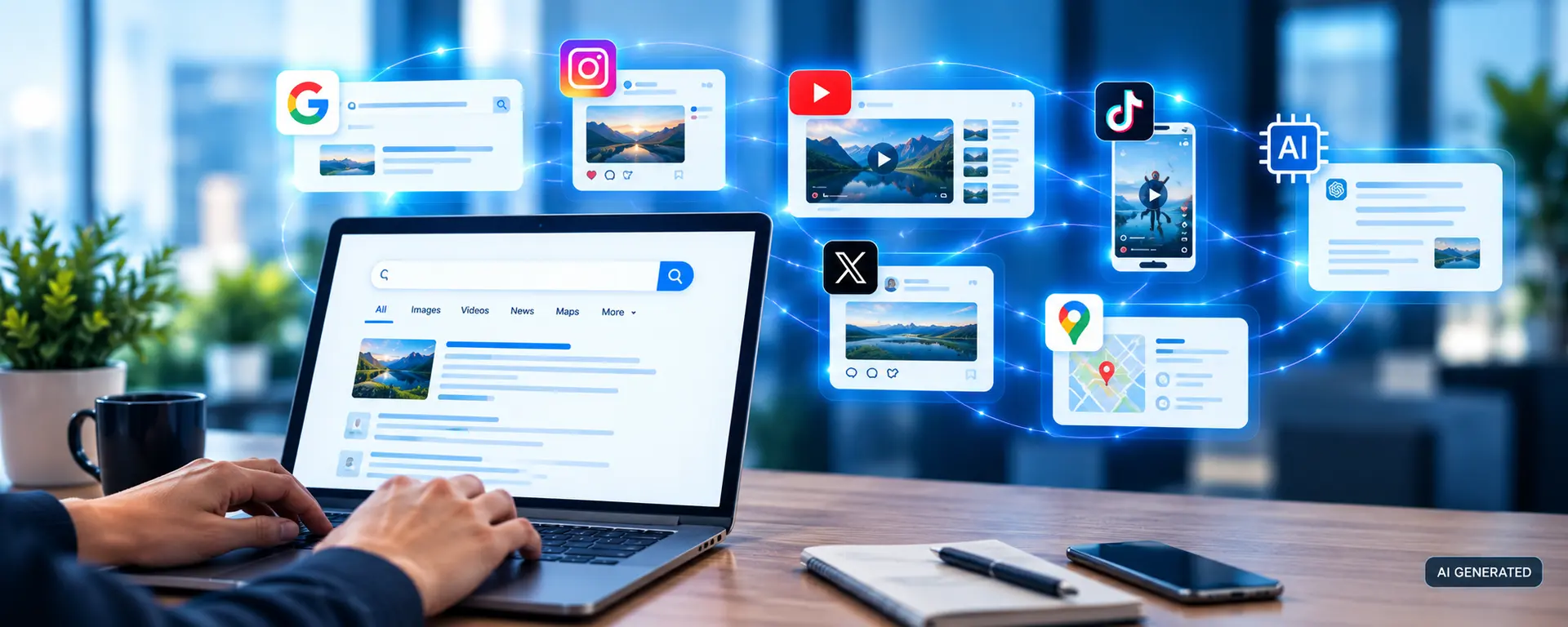
The Search Ecosystem: From SEO to Social, YouTube and GEO
How does the new Search Ecosystem look?
This is where Traditional SEO, Social SEO, YouTube Search, and GEO come together.
Traditional SEO helps search engines such as Google and Bing discover, understand, and surface website content. Social SEO helps people discover content within social platforms. YouTube Search helps people find videos that answer questions, explain products, places, or solutions. GEO focuses on creating and structuring information so that AI-powered search systems can understand it and, where relevant, use it to answer questions.
These are not simply different tactics. They are different ways of responding to different search behaviors and intents.
That changes how we think about optimization. Instead of asking only how to rank, we also need to ask what people are looking for, where they look for it, and what makes information useful in that context.
How does a search journey unfold?
People do not always follow a straight path. A journey might start with discovery on Instagram or TikTok, move to Google or YouTube for deeper research, continue through Reddit or reviews to validate an experience, and eventually lead to a website, Maps, or another platform where the person takes action.
The intent can change along the way too. A person might start with inspiration, then look for an answer, compare options, seek a recommendation, or look for someone else's experience before making a decision.
The search journey helps us understand what people need at each moment — and that should shape the content we create.
What does it mean to optimize for the Search Ecosystem?
It means moving away from the idea that content is created once and distributed everywhere. Instead, we start with what we know about our audience, their needs, and their questions.
- A website can provide depth.
- YouTube can explain or demonstrate.
- Social platforms can support discovery and inspiration.
- Communities can add real experiences and perspectives.
- AI-powered search can provide another way to access and explore information.
The information may be related, but the content, format, and experience should reflect what the person is trying to accomplish.
For a Search Ecosystem strategy, the question is therefore not simply “How do we rank?” but “What does the person need at this moment, and where are they looking for it?”
The answer should shape how we communicate, what we create, and where we make it available — from the language and format we use to the type of content we create, the signals we consider, and how we measure success.
That is what it means to think beyond SEO and build for the Search Ecosystem.
Ready to make your content work across the Search Ecosystem?
DRIVE helps companies turn their knowledge and expertise into content that people can discover, understand, and use across SEO, social platforms, YouTube, and AI-powered search.

Lina Garcia
More blog posts

Advertising that thinks ahead? How ChatGPT Ads are changing online marketing
We know advertising on Google. Advertising on Instagram, too. But advertising right in the middle of a conversation with an AI? That is now a reality.

Visual Knowledge: Image and Video as a New Language for SEO and GEO
Companies have far more knowledge than what is visible on their websites or in traditional marketing materials. Products, applications, expert…
SEO and GEO: one shared philosophy for greater visibility
Creating content for a website today means more than simply publishing information and waiting for someone to find it. Search engines and new AI tools…

Poetry Meets Performance: Why the Future of Content is a "Sandwich"
Brands today face a seemingly impossible task: they must touch the human soul while being perfectly understood by artificial intelligence (GEO) and…