ChatGPT Ads are available in Germany – creating an advertising channel that doesn’t just know what someone is searching for, but also what they are talking about right now. For brands, that’s pretty exciting.
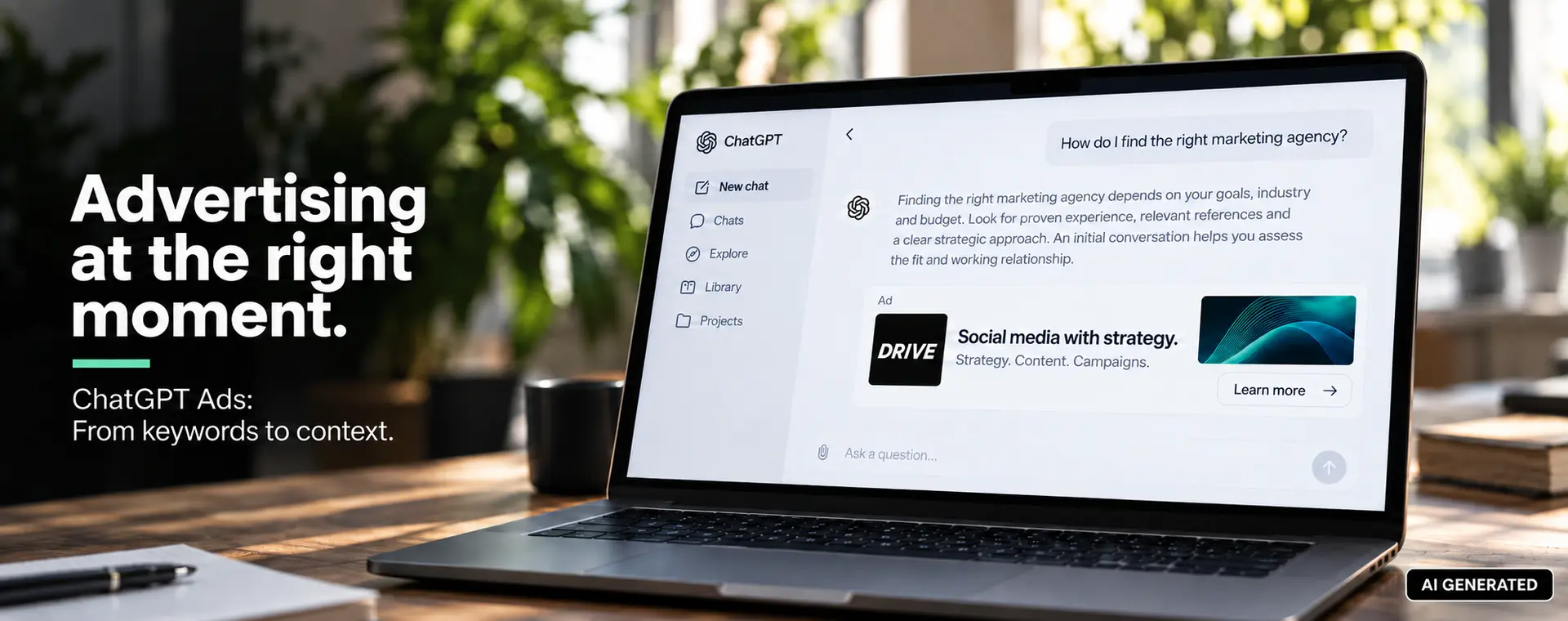
Advertising that thinks ahead? How ChatGPT Ads are changing online marketing
From Keywords to Context
Imagine you’re looking for an agency. On Google, you might type: “media agency Hannover.” A few words. Not much context to go on.
On ChatGPT, your request might look more like this: “We’re a medium-sized company based in Hannover and are looking for an agency to manage our Google Ads, handle social media, and support us with media planning.”
That’s a huge difference. Because when selecting ads, ChatGPT can take the context and intent of the current conversation into account.
Advertisers can also provide so-called Context Hints, describing the topics and situations in which their offering is relevant. The traditional keyword becomes something much more valuable: a specific situation.
Advertising right when decisions are being made
People no longer use ChatGPT just to have a text written for them. They research, compare products, plan trips, look for software, explore their options and make decisions based on the information they receive. That’s exactly where ChatGPT Ads come in.
Ads can appear below a ChatGPT response and may include elements such as a company name, logo, headline, description, image and a relevant landing page.
>One important point: the ad and the answer remain separate. A brand cannot simply pay to have ChatGPT suddenly recommend it as the “best solution.” Ads are clearly labeled as advertising and, according to OpenAI, do not influence ChatGPT’s actual responses.<
That’s not just an important boundary. It’s also crucial for building trust in this new advertising channel.
So, what does it cost?
Of course, the AI world doesn’t work without a media budget either. ChatGPT Ads currently supports three different campaign objectives:
- CPM for reach and visibility, charged per 1,000 impressions.
- CPC for traffic and engagement, charged per valid click.
- And oCPC for conversion-focused campaigns, also charged per click, but optimized toward users who are more likely to complete a desired action.
For CPC campaigns, OpenAI currently recommends starting with a maximum bid of around 3 to 5 US dollars per click. So there is no single “ChatGPT price” for Germany, just as there is no single price for Google Ads.
The actual cost of a campaign depends on factors including bids, competition, relevance and delivery.
Measure, don’t guess
A new channel is great. A new channel whose impact we can actually measure is even better. The ChatGPT Ads Manager already provides access to classic media KPIs such as impressions, clicks, CTR, average CPC, average CPM, spend and conversions.
Conversions can be measured, among other methods, using the OpenAI Pixel. Tracking parameters such as UTMs can also be used and integrated into existing analytics setups.
For us as a media agency, that’s exactly what matters. Because in the end, we’re not interested in whether AI advertising is simply new and exciting. We want to know: Does it reach the right people? Does it generate qualified traffic? And does it actually contribute to business success?<
Is ChatGPT the new Google?
No. At least not yet. But that’s not really the point. What’s much more interesting is that we’re entering a new phase of the digital customer journey.
Google Ads reaches people through their search queries. Social ads reach people based on interests, behavior and platform signals. ChatGPT Ads, on the other hand, reach people who have already described their problem, requirements and needs in considerable detail.
That makes the channel particularly interesting for products and services that require explanation: software, travel, consulting, B2B offerings or products where a decision requires more information and consideration.
That’s where conversational advertising can play to its strengths: an ad can appear at a moment when there is already a specific need.
So, what now? Just throw some budget at ChatGPT?
Please don’t. Just because ChatGPT Ads are available doesn’t mean the channel is automatically the right solution for every brand. Since the end of August, companies based in Germany have been able to book ChatGPT Ads themselves through the self-service Ads Manager. Getting started has therefore become considerably easier.
Even so, we approach a new channel the same way we approach any other: Define the objective. Understand the target audience. Form a hypothesis. Test. Measure. Learn. Optimize.
Technology doesn’t replace good media planning. It gives us new possibilities to work with.
The DRIVE factor: AI meets media
At DRIVE, we’re deeply engaged with how artificial intelligence is changing communication. Not just in content production. Not just in SEO and GEO. Increasingly, we’re also looking at the question of where brands can actually reach their target audiences.
ChatGPT Ads are a pretty good example of this: Search becomes conversation. Keywords become context. A new AI tool becomes a new media touchpoint.
Whether it will become a relevant performance channel remains to be seen over the coming months. What is already clear is that AI is changing not only how content is created and information is discovered. It is also creating new places where brands and potential customers meet.
And we’d rather take a close look now than play catch-up later.
Ready for the next media touchpoint?
Want to know whether ChatGPT Ads make sense for your brand, your target audience or your next campaign? We’ll explore the possibilities, develop a suitable test and focus above all on what matters in the end: impact.

Sahar Hasan
More blog posts

Visual Knowledge: Image and Video as a New Language for SEO and GEO
Companies have far more knowledge than what is visible on their websites or in traditional marketing materials. Products, applications, expert…

SEO and GEO: one shared philosophy for greater visibility
Creating content for a website today means more than simply publishing information and waiting for someone to find it. Search engines and new AI tools…

Poetry Meets Performance: Why the Future of Content is a "Sandwich"
Brands today face a seemingly impossible task: they must touch the human soul while being perfectly understood by artificial intelligence (GEO) and…

The Tyranny of the Average: Why AI Entertainment Comfortably Bores Us – And Why True Creativity Demands Leadership.
Anyone scrolling through TikTok or Instagram experiences déjà vu on a continuous loop: identical pacing structures, interchangeable aesthetics, and…