Voice Control & Search
Is the marketing manager of the future called a chatbot?
Chatbots – technology, examples of use, state of research, outlook
The topic: What chatbots, intelligent personal assistant systems, language- and/or thought-based, can achieve in dialogue and as service tools. Prof. Dr. Thomas Osburg researches and writes about chatbots and intelligent assistance systems – very exciting! He presents how chatbots can take over dialogue tasks in customer and individual communication. For example:
- Hotline services are simplified, waiting times are reduced
- Social programs are improved
- Multitasking is made possible, e.g., jogging and talking on the phone at the same time
- Intelligent service offerings: your car alerts you to parking opportunities, shopping, and much more
- From medical technology: you can control your wheelchair with your thoughts, e.g., for paraplegics
- Your clothing or wearable measures bodily functions and offers suggestions.
... and much more. Plus references to studies, examples of use, results, and outlooks. Exciting aspects include the transition from voice control to mind control, e.g., in the above-mentioned steering of wheelchairs, and the experiments and results related to this.
The occasion: muk.net conference event to mark the 80th birthday of Professor Uschi Hansen, our teacher to us all. A kind of class reunion in her honor, with lectures, workshops, discussions, and lots of fun, on October 25, 2019.
The audience: professors, doctoral students, graduates—we were all taught by Professor Hansen.
The discussion: surprising. A large group of young and older professors and other bright minds were negative about the topic and the technology. Their arguments: there was no personal connection. And the men couldn't imagine, for example, jogging AND talking on the phone at the same time; in their opinion, it was either one or the other.
Initial findings and how to deal with new technology topics
Great topic, exciting presentation. Exciting technology, thrilling, full of possibilities!
But it is somewhat regrettable that the discussion is being conducted by scientists of all people in such a way that personal antipathies and reservations without any factual basis or further examination, based purely on their own subjective experience, are being used to oppose further development with skepticism and thus as an obstacle. It would be nice if they would fulfill their role as gatekeepers, opinion leaders, and role models for practice, teaching, and research more openly in this topic, which is probably new to them.
- 1. What can a new technology do? Does it work, does it do what it is supposed to do?
- 2. What are the possibilities? What is it suitable for, what can be done with it, how does it work, where and how can it be improved?
- 3. And only then should the evaluation follow: Is it good or bad, where should it be “improved” and why ...
Is this form of technological skepticism one of the reasons why Germany is often not far enough ahead in innovation and technology issues? This was exactly the case with all new media in the initial introduction phase, including the introduction of the Internet and social media.
What is being ignored here is that behavior and usage patterns can and will change completely from one generation of recipients to the next. Look at how your children interact with media—this is a tip from another participant in the audience.
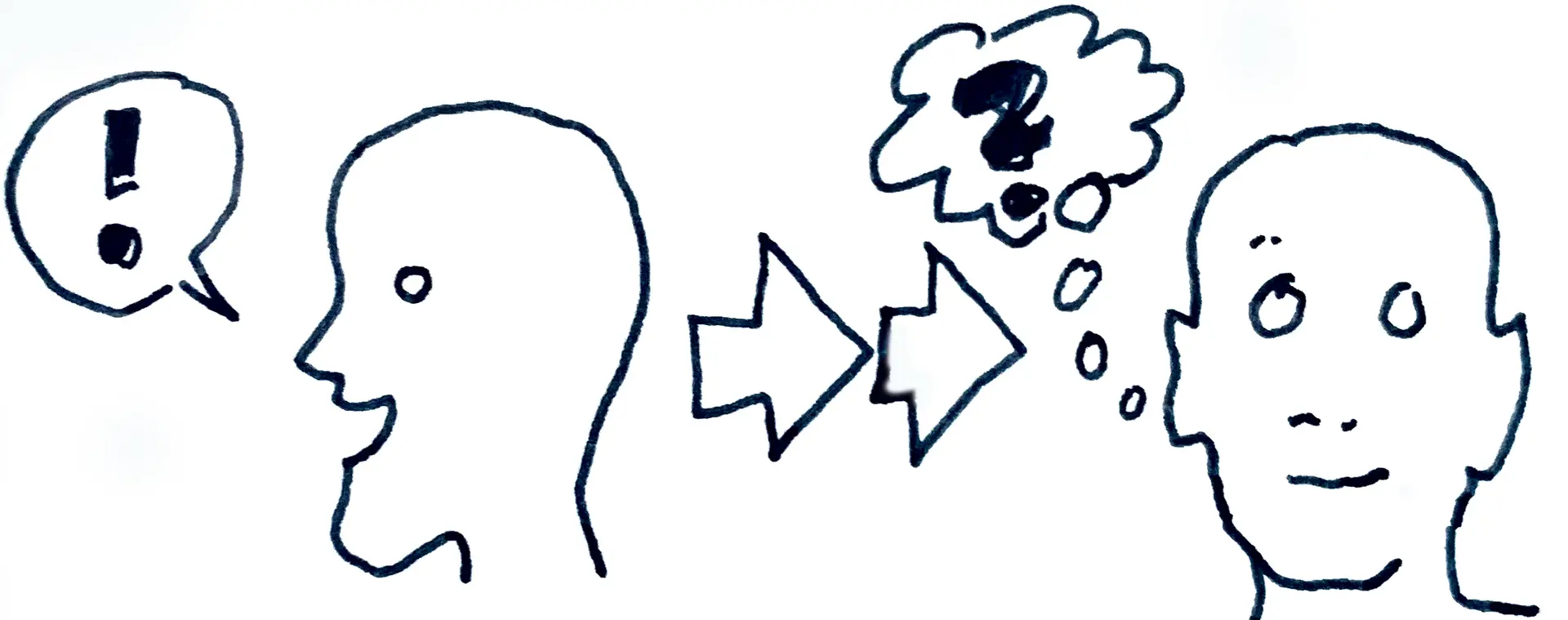
The “imagined relationship”
Good dialogue communication already worksthis way, for example on a website or in an app: Both dialogue partners, sender and user, imagine their relationship, trying to make it as personal as possible, even if they are separated by time, space, and situation and are only connected via the medium. If one of the participants does not experience a feeling similar to that of a personal relationship, this is not necessarily a failure of the medium itself, as the skeptical discussants suggest. Rather, it is simply a case of poorly designed communication, nothing more.
Young recipients learn very early on to imagine talking to an intelligent machine. This is how their gadgets, games, TV series, films, and much more work: “The Flash,” “Star Trek,” “Star Wars,” “Knight Rider,” “The Vision” from The Avengers, and many more. In these stories, intelligent systems talk, discuss, and can be controlled through thoughts and language. And children and adults learn from this too. So here's a TV tip for professors (except Thomas Osburg): binge watch superhero TV or just dig into your own pop culture adolescence experience box.
Suggested name: “Personal Intelligent Assistant”
The name: this could use some work. “Chatbot” sounds too narrow, small, simple, a little silly. “Personal Butler” has a dusty, British TV series vibe from the 70s. ‘Digital’ is everything anyway. “Personal Intelligent Assistant” sounds better and says what it's about.
For the suggestion: Many thanks, Thomas Osburg!
Recommended reading on the topic:
Schwan, Ben (2019): Gedanken steuern Rollstuhl. Heise-Verlag. (German language link)
Timmons, Adela C. Chaspari, Theodora. Han, Sohyun C.. Perrone, Laura. Narayanan, Shrikanth S., Margolin, Gayla (2017): Using multimodal wearable technology to detect conflict among couples. University of Southern California.
And the link to Thomas Osburg

Stephan Probst
More blog posts

Advertising that thinks ahead? How ChatGPT Ads are changing online marketing
We know advertising on Google. Advertising on Instagram, too. But advertising right in the middle of a conversation with an AI? That is now a reality.
Visual Knowledge: Image and Video as a New Language for SEO and GEO
Companies have far more knowledge than what is visible on their websites or in traditional marketing materials. Products, applications, expert…

SEO and GEO: one shared philosophy for greater visibility
Creating content for a website today means more than simply publishing information and waiting for someone to find it. Search engines and new AI tools…

Poetry Meets Performance: Why the Future of Content is a "Sandwich"
Brands today face a seemingly impossible task: they must touch the human soul while being perfectly understood by artificial intelligence (GEO) and…