On August 2, 2026, crucial transparency rules under the European AI Act come into effect. Anyone publishing photorealistic AI images, deepfakes, or synthetic texts that could potentially mislead the public must clearly label them from now on. To help businesses comply, the EU Commission has introduced a set of standardized visual icons.
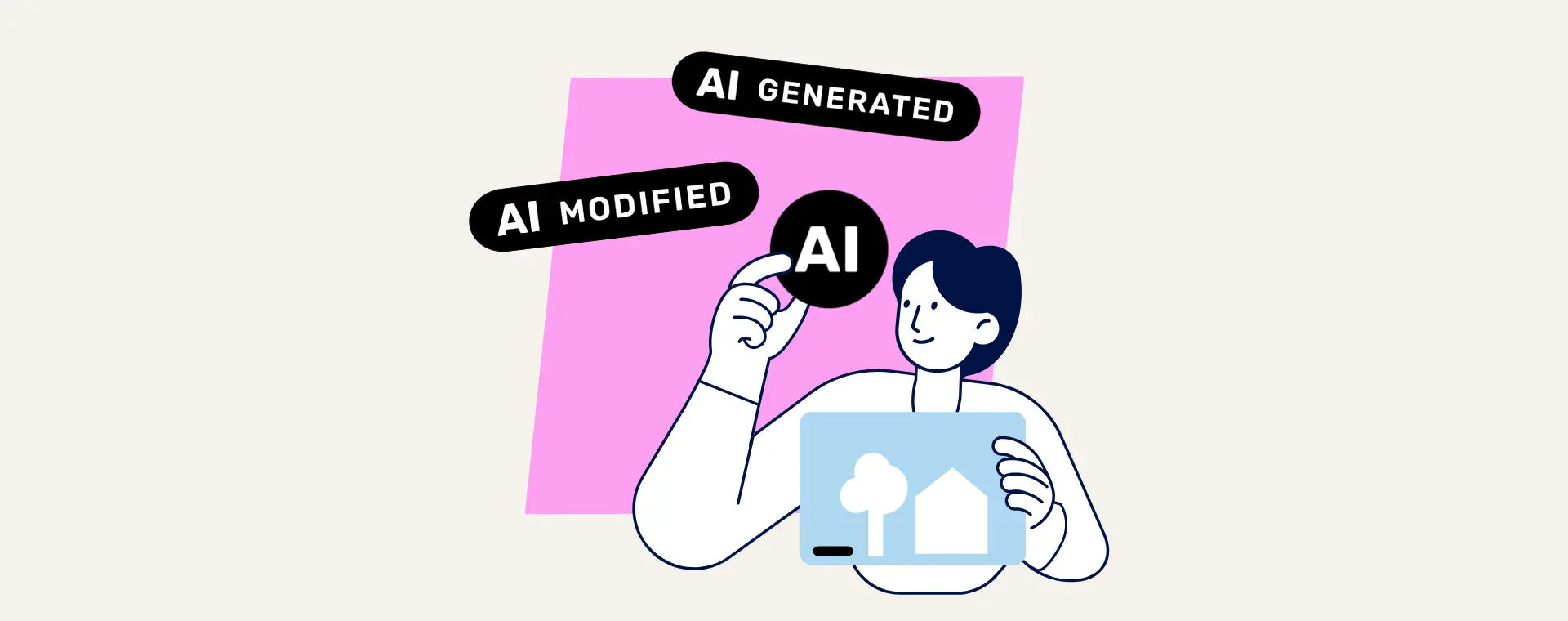
Spotting Deepfakes: The European Commission Launches New AI Labels

Overview of the Three New Icons
The EU provides three distinct icons as a standard baseline, all using English text to maintain international consistency:
- The Core Icon (“AI”): A universal logo that can be flexibly combined with custom text.
- Fully Generated (“AI GENERATED”): For content completely created by AI (e.g., an AI-generated stock photo).
- Partially Manipulated (“AI MODIFIED”): For content based on real footage but altered via AI (e.g., deepfakes or altered image backgrounds).
KI or AI? Choosing the Right Term for Your Audience
Since the official EU icons use the English term "AI", companies operating in the DACH region (Germany, Austria, Switzerland) often face a stylistic dilemma. The following overview helps guide your multilingual content strategy:
| Context & Target Audience | The Term “KI” (Künstliche Intelligenz) | The Term “AI” (Artificial Intelligence) |
| Focus & Acceptance | Standard in German-speaking regions; ideal for local SMEs and consumers. | Dominant in the tech industry, start-up ecosystems, and global marketing. |
| Legal Context | German authorities and media usually refer to the KI-Verordnung. | Global standard; referred to in official frameworks as the EU AI Act. |
| Language Flow (DE) | Sounds natural in compound German words (KI-Bild, KI-Text). | Sounds natural alongside tech terms (Generative AI, AI Tools). |
Our tip for global brands: Use the localized "KI" in German body copy to build local trust, but confidently stick to "AI" for official terms like the "EU AI Act" or "AI Icons" to ensure seamless international continuity.
A Voluntary Standard Securing Legal Compliance
Good news for platform operators and webmasters: Using these specific visual assets is legally voluntary. Businesses are technically free to use their own textual labels.
The benefit of EU icons: They offer a standardized "safe harbor" solution. By implementing the official symbols, you fulfill the transparency mandates of the AI Act in a legally secure and transparent manner. Furthermore, the uniform design fosters immediate user trust across international borders.
Download and Technical Integration
The icons are readily available for download on the European Commission's digital platforms. To ensure they match any corporate identity, they are provided as scalable vector graphics (SVG) and PNG files in black, white, and a 50% transparent finish.
Exemptions: Content that is clearly artistic or fictional (e.g., a flying sphinx), as well as internal AI tools that are not accessible to the public, do not require mandatory labeling.
Want to make your website or platform compliant with the EU AI Act?
Implementing AI labels correctly requires technical precision and smart design—especially within multilingual corporate platforms. As your trusted digital partner, the team at DRIVE helps you seamlessly integrate the new standards while remaining fully GDPR and AI Act compliant.
Get in touch with the DRIVE experts today to future-proof your digital presence!

Stephan Probst
More blog posts
Advertising that thinks ahead? How ChatGPT Ads are changing online marketing
We know advertising on Google. Advertising on Instagram, too. But advertising right in the middle of a conversation with an AI? That is now a reality.

Visual Knowledge: Image and Video as a New Language for SEO and GEO
Companies have far more knowledge than what is visible on their websites or in traditional marketing materials. Products, applications, expert…
SEO and GEO: one shared philosophy for greater visibility
Creating content for a website today means more than simply publishing information and waiting for someone to find it. Search engines and new AI tools…

Poetry Meets Performance: Why the Future of Content is a "Sandwich"
Brands today face a seemingly impossible task: they must touch the human soul while being perfectly understood by artificial intelligence (GEO) and…