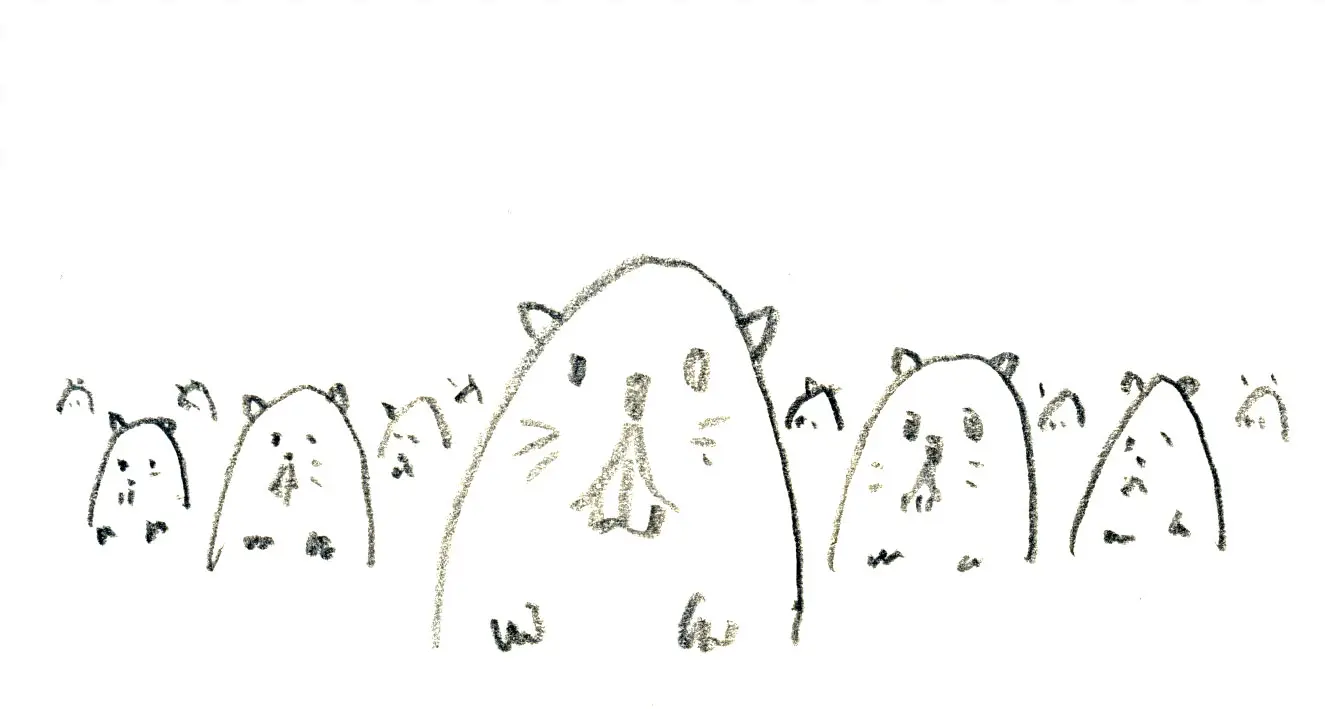
How to build up a stupid community
Dear readers, What does a social community need to function well, for a long time, and profitably? Here, our guest author Johnny W. TRASH Can, social media expert from the dark side of the force, writes about how he thinks communities work. And this applies to cults, churches, political parties, dog breeding clubs, and boy band fan clubs just as much as it does to Instagram “communities.”
A.) WHY?
Hey there, true believers! Why would you need a “stupid community”? Three reasons.
- 1. It's easy to build.
- 2. It's easy to run.
- 3. It's easy to make money with it.
Or whatever you've set as your goal in terms of rewards, earnings, or enjoyment. And that's how we do it on the dark side of the force.
B.) HOW?
So how do you build a “stupid community,” run it, and keep it alive? Just follow the rules.
1. Find the GLUE
Find a glue. Something that a group of people have in common, like together, do together. For example: “We love children,” “We love cats/dogs/hamsters...” (It also works the other way around: “We hate...” works even with cats.) Everyone can agree on this, they all agree. And that's your basis. IMPORTANT: It shouldn't be too complicated. So not: “We love Shakespeare.” Because you want a community that is as simple as possible. Complex topics are not appropriate here. You're not looking for smart people as a basis.
2. Define the ENEMY
WHO is your enemy? Once you know what you like, point out the person or people you DON'T like. For example, everyone who doesn't like children, cats, or hamsters. Why? Nothing binds a group together more than someone who threatens you all from the outside. A common enemy is the most important thing for cohesion. IMPORTANT: Don't make it too complex. Either ONE common enemy or ALL others. With two or three enemies, you quickly lose track.
3. Give yourself a SYMBOL
You should recognize each other by your signs and symbols, which signal to each other that you “belong.” These can be anything, but they shouldn't be too difficult to obtain. For example: watches, cars, tattoos, etc.
Established communities, on the other hand, make it much more difficult to obtain their signs and symbols. You have to take and pass tests to earn qualifications. That's not what you want! Most of your people haven't achieved that; many of them probably even failed or were rejected. That's why they're a good fit for you and your goals. You make it easy for them and still make them feel good. Good start.
- The CENTRAL symbol is the most important and takes precedence over all others. It appears everywhere when it comes to YOU; it represents YOU and YOUR goals.
- The ACCOMPANYING symbols and signs reinforce the meaning. They remind people of it and refer to it.

4. Admire your IDOLs, create them and pump them up
You need an idol—someone everyone can admire and look up to. Someone like Cristiano Ronaldo, Donald Trump, or Greta Thunberg, for example, can work well. Ideally, they’re already famous. If not—create them yourself. Who and how? That’s one of the trickiest parts.
- “SMOOTH” – your idol should offer lots of space for projection.
This means people should be able to project many positive qualities onto them. The ideal example is someone like Tintin from The Adventures of Tintin: zero real personality, somehow stands for everything and nothing at once. It also helps if the person is no longer alive—a dead pharaoh, for example, can’t object or act unexpectedly.
- “CHARGEABLE” – you should be able to fill your idol with whatever you need.
- “RECOGNIZABLE” – your idol should be easy to iconify. It needs something distinct and memorable.
- “MOLDABLE” – you must be able to guide, shape, and control your idol easily.
- “GOOD” – your idol should be good at something.
- “Exceptional” is nice, but “decent” is good enough to start.
- “PROVABLE” – this excellence should be demonstrable. And if not? Just keep repeating it often and confidently—that’s usually enough.
IMPORTANT: Always create and offer new opportunities for your idol to be admired—consistently and with staying power. That’s what we’ll cover next.

5. BUILD UP A RANKING SYSTEM
Create differences. Who is at the top, who is further down? At first, it may seem as if everyone is equal. But that's not true at all. Newcomers are below the older ones, those who have been “around” longer. This creates incentives to move up. And the higher you climb, the deeper you get into the inner circle, the harder it is to get out again. And that's what you want.
- Important: The rankings must be visible. Award medals. Make it important.
- When they join, newcomers are clearly ABOVE everyone who does NOT belong to your community. This means that you have to give them a badge right from the start. Something that distinguishes them as your members and clearly sets them apart from everyone who does not belong. Joining makes newcomers BETTER.

6. Install a cast of priests
You need distinguished and initiated individuals who will proclaim your gospel, your teachings, and your wisdom. These individuals are naturally higher up in your ranking. What makes them special is that they have additional important tasks to ensure the preservation, growth, protection, and future of your community.
- They initiate.
- They distinguish.
- They judge and decide.
- They proclaim and interpret.
7. Give rules. Donate rewards & impose sanctions
Reward and punish. More of one, less of the other—how much depends on the nature of your community, its members, your goal, and how you distinguish yourselves from the outside world. Carrot and stick—it's all about the right mix. How and when do you reward or punish? You determine that by creating rules. Which ones is irrelevant at first. The important thing is that they can be fulfilled, then you get a reward. But you can also violate them and therefore fear punishment. The sanction system is therefore at least as important as the rewards.
8. Celebrate rituals
Create rituals that bring your community together and allow them to celebrate themselves and gain self-confidence. An example: Our sailing club organizes a sausage barbecue once a year. All “deserving” members are honored, see above. How do you earn merit?
- a) Through special athletic achievements. >>> See the rankings and idols you create for yourself and who are at the top.
- b) Through time and membership. This means that you don't have to do anything special, just be there for a long time. Anyone can do that.
Events and awards always follow the same pattern. This creates security and certainty. The awards are worn visibly. This distinguishes some from others. Those at the top of the rankings are the masters of ceremony or at least have special tasks. This sets them apart and ensures that everything runs smoothly. The result: the community reassures itself and everyone else in a clearly visible way. The future is secure for another year. Until next time. If something like this is canceled, it's a disaster. Because then a replacement is urgently needed. It's no different at party conferences, church services, and ultimately in every small social media community. No rituals? Then there is no reassurance and therefore no bond: not formal or symbolic, and therefore not cognitive or even emotional.
9. Create a code
Now it gets more complex. Create a code, a language, a collection of signs and symbols whose meaning is known only to your members, the “initiated,” so to speak. Those who do not understand it remain outside. You develop the code from your central symbols. This makes it appear “coherent” to everyone.
10. Communicate through your own channels
You need your own media through which you can communicate with your members. But be careful: if you leave some out, you won't be able to reach them anymore and you'll lose them. This may strengthen the bond with those you still have. But in the long run, it weakens the community because it becomes smaller. So choose your media carefully. Make sure you reach EVERYONE, that they enjoy your messages regularly, and that you don't leave anyone out.
C) WHO?
Now you know how it works. But who do you want to do it with? Here are a few good and simple tips to round things off. It's all about WHO fits well into a social community and WHEN is the right time to build one. Sure, you can phrase it all nicely and politely. But plain speaking is better.
THE MORE STUPID THE BETTER
You definitely don't need free spirits, intellectuals, or otherwise enlightened citizens. They'll just complicate things for you. They ask questions, raise objections, even have their own thoughts... You don't want any of that, and you can't use it because it creates work for you. Make sure that they get their information, wisdom, and insights from you alone, if possible. Or put a filter in place so that all information is filtered the way you want it to be. Then you'll have peace and quiet, and the community will just stew in its own juice and take in as little as possible from the outside world.
NOT TOO MUCH MORAL
The fewer values or stable value systems your members already have, the better. Because then you can fill them up with your own system.
FREE THE SUPPRESSED
Also good: if they are oppressed by the ruling, dominant system, or at least perceive themselves to be. Then you can build them up and give them new meaning and value. Basically, the more suppressed, the better.
MAKE THEM ANGRY
Use their anger. Channel it. That's why you chose your enemy. And aggression is good here. Against the enemy, what he or she or it stands for. But control it.

D) WHEN? NOW!
When is the best time? Always. The best time is now!
THE “THREADS-CAVE-COWARD-DESIRE” MODEL
This is the image of a poor human being sitting in his cave, afraid of the dangers of the big world outside.
- Enormous “THREADS” from outside: “There are great dangers lurking outside, and they all threaten me greatly.”
- My safe ‘CAVE’: “Here I am safe, here I have protection. But I hardly notice anything from outside. Least of all through my own experience.”
- I'm just a small “COWARD”: “I am so small, defenseless, and afraid, robbed of everything that made me big and strong.”
- But I still have a ‘DESIRE’: “It could be so beautiful, that's what I want.”
IN UNCERTAIN TIMES
When times are perceived as uncertain. When threats are seen from outside. When people are afraid and want to be reassured.
IN AN INSECURE ENVIRONMENT
In an uncertain environment. Where people seek protection from external dangers, real or imagined.
MAKE THEM COWARDS
But what if that's not the case? What if there are no dangers lurking outside and we don't live in uncertain times? It doesn't matter! Make them believe that it is. Make them believe: there is danger outside. The stronger the subjectively perceived threat, the more willing they will be to hear your messages. In which you promise them protection, give them hope and new strength. And instill in them a great desire: that they want to belong to you and your strong community.

Summary
So what you need is the following:
- a number of individuals who are uncertain and whom you form into a group
- with a common goal, common values,
- signs and symbols through which they communicate,
- a structure and processes.
This gives them stability and hope. And this is how you form them into a community and lead them as such. So: have fun with it. Make money. And don't try to become a better person with this knowledge! Or improve the world? What nonsense.

Stephan Probst
More blog posts

Advertising that thinks ahead? How ChatGPT Ads are changing online marketing
We know advertising on Google. Advertising on Instagram, too. But advertising right in the middle of a conversation with an AI? That is now a reality.

Visual Knowledge: Image and Video as a New Language for SEO and GEO
Companies have far more knowledge than what is visible on their websites or in traditional marketing materials. Products, applications, expert…

SEO and GEO: one shared philosophy for greater visibility
Creating content for a website today means more than simply publishing information and waiting for someone to find it. Search engines and new AI tools…

Poetry Meets Performance: Why the Future of Content is a "Sandwich"
Brands today face a seemingly impossible task: they must touch the human soul while being perfectly understood by artificial intelligence (GEO) and…