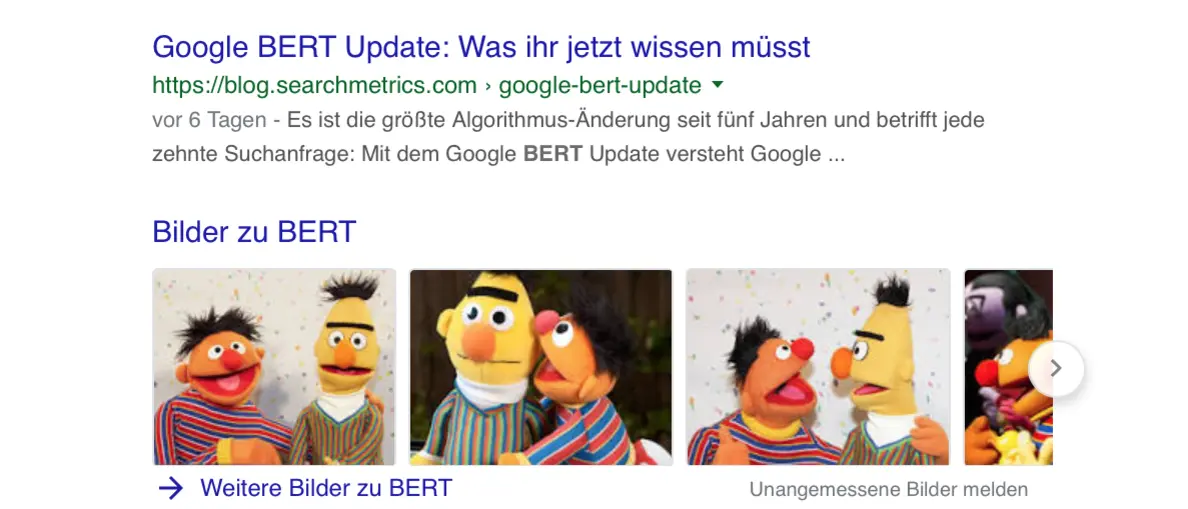
Introducing BERT – the biggest Google update in five years
WHO OR WHAT IS “BERT”?
The whimsical abbreviation “BERT” stands for “Bidirectional Encoder Representations from Transformers.” BERT was developed as an algorithm model that uses natural language processing (NLP), a model of neural networks designed to understand the complexity of human language, to make search results more closely resemble real human communication. The words in the search query are to be interpreted more in relation to each other, and the result should better reflect this relationship.
HOW DID YOU TRY TO ACHIEVE THIS?
The basis for this is formed by the so-called “Transformers” computing models: they relate a word to all other words in a sentence and do not just track the meaning word for word. This means that understanding prepositions and their meaning, as well as the position of individual words within a search query, becomes much more important.
Google does this because, according to its results, around 15 percent of all daily search queries are asked for the first time. In addition, search queries are becoming increasingly similar to real human communication, partly because voice search is becoming more important. The strategic intention to promote this feature more and more is certainly also playing a role here. Others see it similarly, with some forecasts predicting up to around 50% of search queries being voice-based within two years!
What's more, search queries are becoming longer and therefore more complex. In order to provide quick and accurate answers, the underlying technology must work precisely and efficiently – and that's what BERT aims to do. BERT therefore primarily affects long-tail search queries. BERT can better understand longer search queries that are entered into the search bar as a question or phrase or spoken as a voice search query.
WHAT TO DO?
BERT has been active in the US since October 24, 2019, writes Pandu Nayak, Google Fellow and Vice President of Search, in a blog post. It affects one in ten search queries. BERT is not yet active for German organic search results, but will be rolled out gradually for other country indexes. Elsewhere, it is emphasized once again that there is no release timeline for other countries.
However, BERT does affect the so-called featured snippets, which appear above the organic search results as position 0 with text, a table, or a list. It is already being used in all 25 languages in which these are used, including in German search results.
THAT MEANS: THERE IS DEFINITELY A NEED FOR ACTION!
Do you have any questions? How can you best work with BERT? Feel free to send us a private message at pole-position[at]drive.eu.

Stephan Probst
More blog posts

Advertising that thinks ahead? How ChatGPT Ads are changing online marketing
We know advertising on Google. Advertising on Instagram, too. But advertising right in the middle of a conversation with an AI? That is now a reality.

Visual Knowledge: Image and Video as a New Language for SEO and GEO
Companies have far more knowledge than what is visible on their websites or in traditional marketing materials. Products, applications, expert…

SEO and GEO: one shared philosophy for greater visibility
Creating content for a website today means more than simply publishing information and waiting for someone to find it. Search engines and new AI tools…

Poetry Meets Performance: Why the Future of Content is a "Sandwich"
Brands today face a seemingly impossible task: they must touch the human soul while being perfectly understood by artificial intelligence (GEO) and…