Time seemed to stand still on the uncomfortable wooden chairs in the stuffy classroom. School hours dragged on like chewing gum – but even otherwise, it felt like we were in a bygone century. Presentations were drawn by hand on huge posters, and overhead projectors were a mandatory fixture in every classroom. Operating the buzzing image projectors seems to be a compulsory subject in teacher training. Or are teachers just so talented at quickly familiarizing themselves with new devices?
The Internet – a mystery
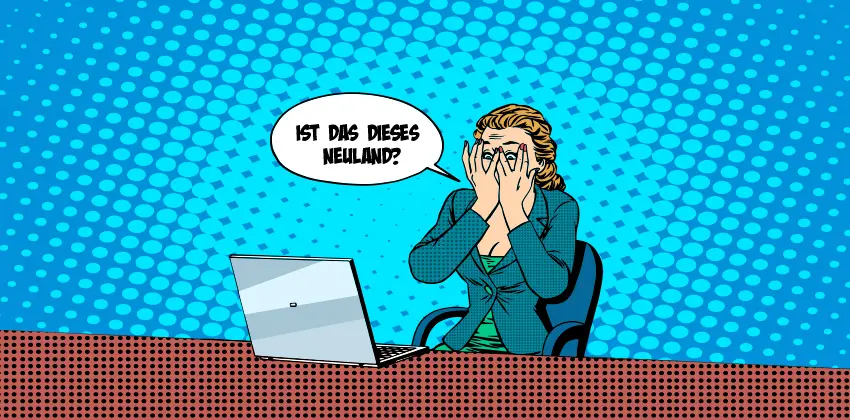
Since Corona, at the latest, we all know that this is not the case. The sudden transition from the (blackboard) chalk era to the digital world of the completely unknown medium, the INTERNET. Despite their extensive knowledge of different eras, history teachers are completely unfamiliar with this. But who would have thought back then that this strange, newfangled thing would catch on? And now it's here, striking like the Big Bang, completely unexpected: Bam! And lo and behold: the era of digitalization has arrived in our classrooms.
There is no escape!
Teachers didn't run away in panic like people did when they saw the first motion picture and thought the train was about to jump out of the screen and run them over. Nevertheless, most teachers would probably have preferred to flee from the new challenge. Thanks to travel restrictions, curfews, and stay-at-home measures, that wasn't possible: they had to face their enemy!
Every beginning is difficult
The first attempts to hold a virtual math class were probably as much uncharted territory as the first telephone call between Alexander Graham Bell and Thomas Watson. It's just strange that Bell didn't choose the now popular, but also nonsensical, opening line, “Can you hear me?” Apparently, even people in the 19th century were more adept at dealing with new media.
So far, so
good Overall, of course, the coronavirus has had a predominantly negative impact. However, when it comes to understanding how important digitalization is for our education system, the pandemic has helped us make some progress. Learning platforms are being further expanded, and teachers and students alike are being trained in how to use the new channels. The initial crises are gradually subsiding, and a routine is becoming established.
What can we learn from this?
Even if they initially seem like insurmountable obstacles, there is always something positive to be gained from some bad situations. There is still room for improvement in our classrooms, but we have made a start.