What is the current situation? Is the economy collapsing, is everything in ruins, is there disorder, chaos, uncertainty – is that the situation in many companies, cities, communities, and households? One thing is certain: that is how it looks in the minds of many, if not most, of those affected. Many are asking themselves: What will happen next? Is there hope, confidence, or at least the prospect of a solution or improvement? This is dangerous, because now seems to be the moment when opportunists in communication will strike!
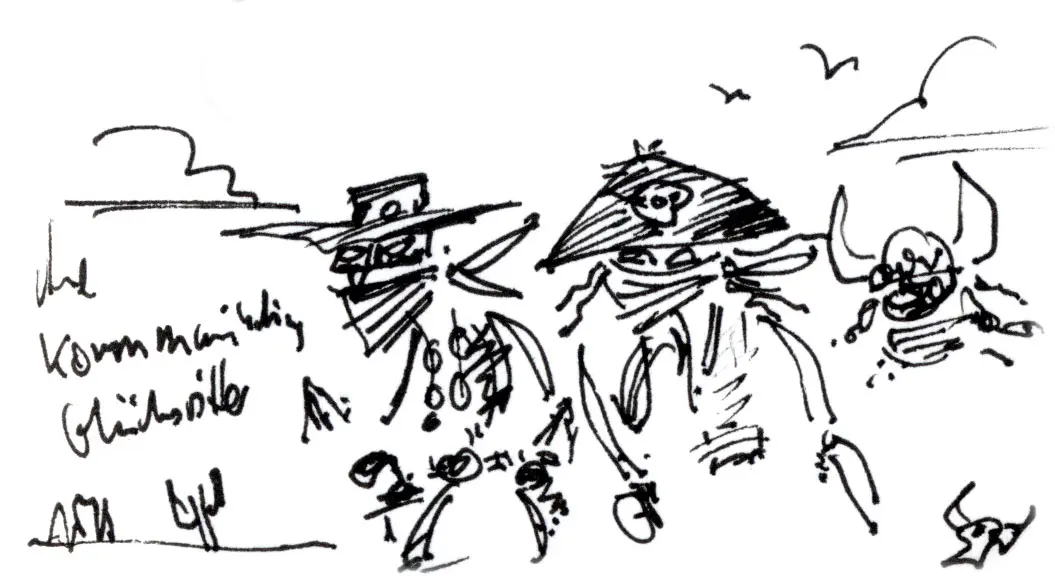
Is everything on the ground? How communication should be now
The era of communication adventurers
There are opportunists out there promising quick success, new sales, new clients, new products, and an immediate improvement in the situation. What are the supposed solutions they use to lure entrepreneurs?
1. Success through mystical, mathematical “foolproof algorithms”?
According to rules, results would almost certainly occur with certain frequencies. Mathematical certainties are assumed, but these are often not explained and remain vague and uncertain. The problem: we are used to such statements from working with search engines such as Google, accept them, and act accordingly. Even though we do not know the exact rules according to which a website is displayed higher or lower in the search results for a particular search term. The entire SEO industry acts according to such myths, which are fueled by Google, with little tips, hints, possibilities in blogs, and on requests that supplement the basic set of technical requirements. And the opportunists have found new fields in which to copy the pattern: primarily in social networks. They send mass emails and messages with supposedly personal messages to their “targets,” their victims, promising them the same method as a solution.
2. Success through “irrefutable laws of nature”?
Humans are beings who act according to certain biologically predefined rules. These rules must be triggered, and then a certain behavior will follow with certainty. Often, it's about “pain points,” i.e., points at which the other person enters areas that cause them fear. Most of the time, however, it's simply “laws of nature,” meaning, “That's just the way it is.” These are, of course, very complicated, so people like to refer to “messenger substances,” “hormones” that flow through the body and then trigger the desired behavior, and much more. It sounds practical and simple, but it's not very scientific; in most cases, there is simply a lack of foundation and evidence.
We claim: Humans are smart. Sometimes we use our brains.
Regarding 1. Algorithms are built by humans and are based on the past
Their creators make assumptions about them, e.g., about gender, race, behavior, attitudes, sometimes even objectives. These shape the results and influence rankings, for example, based on expectations. Furthermore, they are based on data collected from events that have already occurred, i.e., the past. They extrapolate this data into the future and, at best, derive possible developments from it. In rapidly changing times, environments, and constellations, this must remain uncertain.
Nothing against mathematics, quite the contrary. But the fundamentals MUST be comprehensible and transparent, the figures complete or at least representative, and the results valid and reliable! Otherwise, it remains mere number mysticism instead of a real foundation.
Regarding 2: We learn. And we see through tricks. Especially when they appear in large numbers.
A stimulus leads to a certain response – nothing more than this “old hat” is claimed, only now a little more complicated, spiced up with a little “magic.” When do such biological models usually appear? When explanations and trust are lacking – in others, in oneself, in the entire environment, in the future, and in everything in general. This is what needs to be worked on.
Everything for behavioral science: it's good and immensely important! We love and use very good scientific findings that lead us to new insights about ourselves, our motivations, and our behavior. But: we must be careful with mere assertions that are put forward without basis or evidence and deny that humans also have brains and are capable of reflection and learning. We are not merely creatures driven by instinct, hormones, or other bodily functions (perhaps sometimes, but not always).
The danger: with such tricks, we damage our credibility and ourselves.
That is, when the deception is exposed. When “targeting pain points” or other supposed “laws of nature” are learned, recognized, and overcome. When algorithms no longer apply. When everything continues to change and nothing remains as it was and is. And once that happens, there is no longer any basis for building relationships, neither in the long term nor in the short term. Which is what communication is supposed to achieve.

What is the better way? Truth, clarity, usefulness.
Everything starts with a question, a starting point: What do the dialogue partners need? What do the environment and everyone around us need? What are their wishes, requirements, objectives, and plans? Everything is geared toward this. Everything else follows from this: What real benefits can we truly offer them?
Important 1: Communication should help...
- solve problems in the long term, meet challenges and overcome them;...
- convince by clearly demonstrating the benefits for both sides, providing information about goals, not obscuring or using tricks, but being truthful and honest;...
- draw attention by being clear and striking, by showing the things that are important to the other person.
Incidentally, it cannot do this if it simply repeats what everyone else is saying or has already said. It helps to formulate and express things differently from everyone else. This is how you stand out in the vast monotony of algorithms and biologism—a tribute to creativity that produces something unusual and special.
Important 2: Say the right things in difficult times
This should actually be the job of institutions such as churches. But it is precisely their problem that they are currently offering few answers, even though they should actually have “something” to say. In situations like these, companies and corporations are stepping in to fill the void. They convey meaning and thus create order and structure in a chaotic world.
One example: “You Can't Stop Us” by Nike.
Another example: the presentation of the new logo for the Icelandic Football Association. “For Iceland: A new identity for the Icelandic national football teams.” From the presentation: "Since the dawn of time, protectors have watched over the land. Bull. Eagle. Dragon. Giant. They are symbols of the unshakeable solidarity and harmony of a nation that never backs down." Moving and exciting, close and connected, strong and powerful – a complex symbol is explained with powerful statements and images.
Why you should communicate truthfully, clearly, and strongly. Especially now.
- Because it strengthens your credibility rather than damaging it. (Provided, of course, that your actions and overall attitude are consistent with what you say.)
- Because it shows respect and appreciation for the other person, your dialogue partners, and the environment. And that makes you convincing and effective.
- Because it is more powerful than any other form of communication. It is striking. It is memorable and therefore has a lasting impact.
- Because it is simple (functional, technical category), right (moral category), and just (social category).
And because it creates trust.
Which is ultimately the basis of all business. Which is lacking right now and which we all need again. Good communication can and should rebuild and restore this.
No tricks. Just the truth.


Stephan Probst
More blog posts
Advertising that thinks ahead? How ChatGPT Ads are changing online marketing
We know advertising on Google. Advertising on Instagram, too. But advertising right in the middle of a conversation with an AI? That is now a reality.

Visual Knowledge: Image and Video as a New Language for SEO and GEO
Companies have far more knowledge than what is visible on their websites or in traditional marketing materials. Products, applications, expert…
SEO and GEO: one shared philosophy for greater visibility
Creating content for a website today means more than simply publishing information and waiting for someone to find it. Search engines and new AI tools…

Poetry Meets Performance: Why the Future of Content is a "Sandwich"
Brands today face a seemingly impossible task: they must touch the human soul while being perfectly understood by artificial intelligence (GEO) and…