Good marketing for your own location can achieve a lot. But what happens if you forget how to do it? Take the Hanover region as an example.
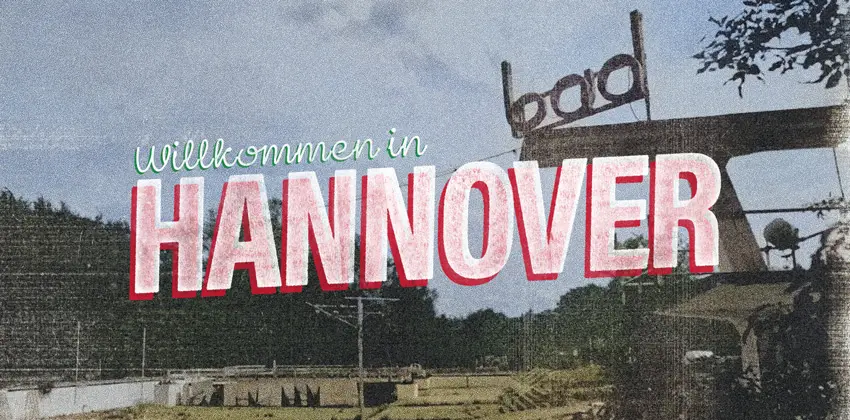
How can I rock my city?
Oh, Hanover, once so beautiful!
How great and magnificent you were in your heyday: the 70s, 80s, 90s, and even into the 2000s.
- The “trade fair city”: venue for major international events, one of the most modern and spacious exhibition centers in Europe, if not the world. Every year, the captains of major corporations met here to determine the fate of the global economy (without passing any judgement on how one might feel about that).
- The rock city and punk center: big bands such as the Scorpions, who sang “Winds of Change,” Jane, Eloy, Fury in The Slaughterhouse, Terry Hoax, The Jinx, Heinz Rudolf Kunze, Scooter, Rotzkotz, Bärchen und die Milchbubis and many others once thrived here in the subcultural roots of the city, with event centers such as the Musiktheater BAD, Leine Domizil, Gig, Capitol, Pavillon, Flohcircus and many rehearsal rooms. German grunge played here, good musicians were a dime a dozen, and making music was part of the culture. We were free, unattached, and always surprising!
- City of Dada, the Nanas, New Objectivity, and pop: Kurt Schwitters, Niki de Saint Phalle, Umbo, Timm Ulrichs ... – a city full of quirky minds, bold thinkers, cheeky spirits, like “ANNA” Blume, as beautiful from the front as from the back. With places like the Sprengel Museum, the Kestner Society, the Kunstverein, the Wilhelm Busch Museum, collections and exhibitions that radiated far beyond Germany and Europe.
- City of philosophers and publicists: Leibniz, Ahrendt, Negt, Augstein ... those who wrote great poetry and thought profound thoughts worked in, around, and on Hanover, rubbing shoulders with you, your rulers, and all living beings. When the great humorist Harald Schmidt was still speaking loudly, not a week went by without a cheerful joke about the city and its character.
- The sports city – suitable for the top league, joyful, and always ready for many sports.
- The EXPO city: cheerful, cosmopolitan, tolerant, global, and free. A model for people from many cultures to meet and live together. Here, everyone should/could/was allowed to feel warmly welcome, and everyone showed their best side.
- The economically strong city: with VARTA, Continental, Volkswagen, Hanomag, savings banks, insurance companies, and a strong middle class—the backbone of any good development.
AND TODAY? THE LACQUER IS PEELING.
There is not much left of the former glory. Hanover is dull and gray. It has neither vitality nor great strength, and certainly no sense of responsibility, because without money, there is not much going on. The economy is weak, young people are leaving, top performers from the (actually) excellent universities are leaving because they are not being retained, even though they are urgently needed for reconstruction, and the city is coming up short in important cultural and sporting competitions...
The problem: the “natural” advantages of the city and region have weakened. They are no longer sufficient on their own to give the city a profile that would enable it to assert itself in national and international competition between cities and regions. Such a situation calls for action: a willingness to change, goals, and measures to set the ship on a good, better course. But are they there?

The guiding principle of “sustainability” is too weak for an entire location
It's not as if the (green) city administration doesn't have something like a mission statement that it wants to follow. It wants to make the city more “sustainable” and “greener”: more bike lanes, cars out of the city center, more energy-efficient buildings... and a few other sub-goals from this complex—all good and noble. But are they enough?
- The goal of “sustainability” primarily serves a specific clientele. Conflicts with other groups that express conflicting interests or even opposition are accepted. Compromise: none. Concession: definitely not. Solution: not in sight. However, for the green milieu nationwide, such an ambition can be of great importance, and failures or even collateral damage in other areas are less significant.
- The formulation of further goals for other tasks is lost sight of. See: the city's website, which is actually the medium best suited for formulating mission statements and measures. It is purely geared towards current events, with news snippets. There is no discernible broader context, perspective, or creative drive, let alone corresponding actions. But what would be important for people, companies, and organizations willing to immigrate, should they consider moving here?
- “Sustainability” has long been mainstream and has long since arrived at many people, companies, and institutions. There is still some catching up to do in terms of implementation, but the groundwork has long been laid, and being “sustainable” is now considered good form. In terms of goals and means, sustainability is a necessary condition for the use of instruments of any kind, but it is no longer a goal in itself; it is not enough. And it seems that Hanover has missed this step in the development of the issue.
Overall, the green administration appears to be unfriendly to innovation, focused on its own core issues, and not sufficiently tech-savvy. The city and region no longer have a clear profile to the outside world. “Sustainability” is not enough to make an impact; being sustainable is not appealing, does not attract people, and does not provide positive impetus, especially if it is only supposed to work through rules and prohibitions. The city is losing its top performers and figureheads. The city is becoming stagnant, believing itself to be sufficient, and dissent seems unwelcome. The age of green Biedermeier, even if it is only short-lived, can have a long-lasting effect. Because there is no clear profile. (Incidentally, from our point of view, from a communication perspective, this does not appear to be a problem unique to this location.)

There is no new, strong, and convincing mission statement.
How can we achieve this? First, we need to clarify our identity. To become strong, we need a solid foundation of analysis and planning, followed by sensible training.
- What is missing first and foremost is a mission statement: clear, strong, distinct, different. Who are we and where do we want to go? Where are we taking others, and why should they come to us?
- Who we are and what we can do better here than elsewhere – a whole lot. But if you don't say it and show it, no one can hear or see it.
- Be beautiful, strong, and smart – and master the art of presenting yourself in an attractive way. This is just as important as clarity and authenticity.
WHAT DO YOU NEED?
- Find your own identity, analyze your strengths and weaknesses: Who are we and where do we stand in comparison to national and international competition?
- Formulate a clear mission statement: Where do we want to go, who do we want to be, for ourselves and for everyone else?
- Find your own advantages that you want to offer. Work towards them.
- Formulate measures to achieve this goal in the best possible way. In steps: 1 year, 3 years, 5 and 10.
- Communicate the goals, internally and externally. Give people a positive vision of themselves. Who they can be. And give them the opportunity to become that.
GIVE POSITIVE OUTLOOKS. BUILD NEW BEACONS.
We need much more of everything.
- Promote innovation, technology, research, and IT. Subcultures of all kinds thrive best when they are given air, love, and nourishment, when they are provided with fertile ground. But no more trade fair cities. Remember the old ones fondly when the occasion arises.
- Put art, culture, and music at the forefront—because they bring people together and attract the best.
- Build ports and bridges, roads and railways. Invite people, don't exclude them. Good exchange is an important foundation, and to achieve this, you have to be open AND look beyond your own horizons, get to know and appreciate what is foreign. Compare yourself, sharpen your skills and simply become better and better. Because the location is unbeatable: Hanover is in the center of Europe, at the heart of all transport routes. This advantage is far too little used and not communicated.
- Improve education and promote the best. Build up the middle class and protect the weak so that everyone can develop together and live well together.
- Strengthen businesses. Without them, a city and a region cannot thrive. They are the backbone, they feed everyone, including administrators and politicians.
- Create events and experiences. People need confidence, joy, and hope.
- Provide security. Strong and stable foundations.
TELL GOOD STORIES.
Every city has stories to tell, and many of them are good. Unfortunately, they are too often overlooked, too rarely told, and usually not appealing enough. But DRIVE can do that: tell stories well. For example, in many excellent projects, including for the cities of Paderborn, Erlangen, Wunstorf, Sulingen, as well as for Hanover, in Braunschweig, and with the German-French Business Club of the Côte d'Azur—we have international experience, speak many languages, think multicultural, openly, freely, globally, and across borders.
LET STARS SHINE...
from research, science, business, music, fashion, culture, art, the intellectual scene, salons, and circles. Give them a stage and space, put them in the spotlight and let them shine. Give them joy, let them live so they can flourish. You can find them, you just have to want to look.
Want to get something started?
That's right — because a good DRIVE is always good. Feel free to inquire at pole-position[at]drive.eu – we look forward to hearing from you.

Stephan Probst
More blog posts
Advertising that thinks ahead? How ChatGPT Ads are changing online marketing
We know advertising on Google. Advertising on Instagram, too. But advertising right in the middle of a conversation with an AI? That is now a reality.
Visual Knowledge: Image and Video as a New Language for SEO and GEO
Companies have far more knowledge than what is visible on their websites or in traditional marketing materials. Products, applications, expert…
SEO and GEO: one shared philosophy for greater visibility
Creating content for a website today means more than simply publishing information and waiting for someone to find it. Search engines and new AI tools…

Poetry Meets Performance: Why the Future of Content is a "Sandwich"
Brands today face a seemingly impossible task: they must touch the human soul while being perfectly understood by artificial intelligence (GEO) and…